
Introduction: AI Is Now a Professional Skill, Not a Technical One
This article focuses on AI Implementation for Professionals for good reason. AI is no longer confined to technical teams or experimental labs. It has become a core capability for modern professionals—consultants, marketers, teachers. dentists, healthcare, and small business owners.
But while interest is high, execution remains uneven. Many professionals start learning through the Best Books on AI before implementing these practices.
Most professionals exploring AI don’t fail because of the technology. They struggle because they lack a clear, structured approach to AI implementation for professionals that connects tools to outcomes.
This guide provides that structure.
Start With Outcomes, Not Tools
The most common mistake in AI implementation for professionals is starting with tools instead of problems.
Professionals often ask:
-
- “Which AI tools should I use?”
A better question is:
-
- “Where am I losing time, money, or opportunity?”
High-Impact Starting Points
For most professionals, AI creates value in three areas:
-
- Efficiency: Automating repetitive tasks
-
- Quality: Enhancing outputs (writing, analysis, research)
-
- Scale: Doing more without increasing headcount
Practical Examples
-
- A consultant using AI to draft client reports faster
-
- A marketer generating campaign variations in minutes
-
- A manager summarizing meetings and extracting action items
Key insight: Effective AI implementation for professionals begins with friction, which result in problems, slowdowns or bottlenecks, not features.
Assess Your Personal AI Readiness
Before adopting tools, professionals need to evaluate their readiness in three areas.
1. Workflow Clarity
AI amplifies existing processes. If your workflow is unclear, AI will amplify confusion.
Ask:
-
- Do I have repeatable processes?
-
- Where are the bottlenecks?
2. Data Access
Professionals rely heavily on unstructured data:
-
- Emails
-
- Documents
-
- Notes
-
- Client information
The question isn’t “Do you have data?”
It’s “Can you access and use it effectively?”
3. Skill Readiness
You don’t need to be technical, but you do need:
-
- Prompting skills
-
- Critical thinking
-
- Output validation habits
Bottom line: Successful AI implementation for professionals depends more on clarity than complexity.
Choose the Right Tools (Without Overcomplicating It)
The tool landscape is crowded, but most professionals need fewer tools than they think. Here is a must-read article on the AI Tools to use.
Core Categories
-
- General AI assistants (writing, analysis, ideation)
-
- Automation tools (connecting workflows)
-
- Specialized tools (industry-specific use cases)
Practical Approach
Start with:
-
- One primary AI assistant
-
- One automation layer (if needed)
Avoid stacking tools too early. Complexity slows adoption.
Guiding Principle
In AI implementation for professionals, simplicity scales better than sophistication.
Design a Simple AI Pilot
Professionals often overthink implementation. The goal is not to build a system—it’s to test a use case.
Step-by-Step Pilot Framework
-
- Pick one task (e.g., writing proposals, summarizing calls)
-
- Define success (time saved, quality improved)
-
- Run a 2-week experiment
-
- Compare before vs. after
Example
A business consultant tests AI for proposal writing:
-
- Before: 3–4 hours per proposal
-
- After: 1–2 hours with AI assistance
That’s a clear ROI signal.
Key takeaway: Effective AI implementation for professionals is iterative, not theoretical.
Integrate AI Into Daily Workflows
AI creates value when it becomes part of how you already work.
Where Integration Matters
-
- Email workflows
-
- Document creation
-
- Research processes
-
- Client communication
What Integration Looks Like
Instead of:
-
- “I’ll use AI when I have time.”
Shift to:
-
- “AI is part of how I complete this task.”
Example Workflow
For a marketing professional:
- Draft campaign idea with AI
- Refine messaging
- Generate variations
- Edit and finalize
- AI becomes embedded—not optional.
Insight: The real leverage in AI implementation for professionals comes from consistency, not capability.
Develop Judgment, Not Just Usage
One of the biggest risks in AI adoption is over-reliance.
Professionals must develop:
-
- Validation habits (checking outputs)
-
- Context awareness (knowing when AI lacks nuance)
-
- Decision ownership (AI supports, not replaces)
Rule of Thumb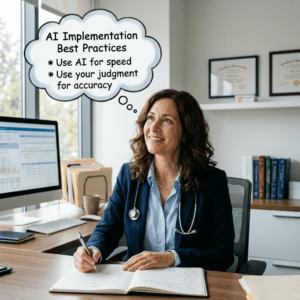
-
- Use AI for speed
-
- Use your judgment for accuracy
This balance is what separates effective from ineffective AI implementation for professionals.
Measure What Actually Matters
Many professionals adopt AI but never measure its impact.
Key Metrics
-
- Time saved per task
-
- Output quality improvements
-
- Increased capacity (more work completed)
Simple ROI Formula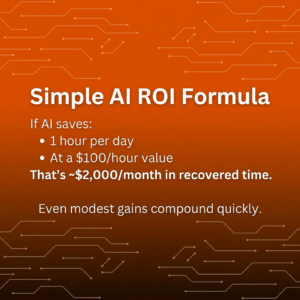
If AI saves:
-
- 1 hour per day
-
- At a $100/hour value
That’s ~$2,000/month in recovered time.
Even modest gains compound quickly.
Takeaway: Measuring outcomes is essential to scaling AI implementation for professionals.
Common Mistakes to Avoid
Patterns are emerging across professionals adopting AI.
1. Tool Overload
Using too many tools too early creates friction.
2. Lack of Clear Use Cases
Without a defined purpose, AI becomes a novelty.
3. Inconsistent Usage
Occasional use doesn’t create meaningful results.
4. Blind Trust in Outputs
AI is powerful—but imperfect.
Avoiding these pitfalls accelerates effective AI implementation for professionals.
The Shift: From AI User to AI-Enabled Professional
We’re entering a phase where AI is not a differentiator—it’s a baseline expectation.
The real shift is this:
-
- From doing the work → to orchestrating the work
-
- From producing outputs → to refining outputs
-
- From individual effort → to AI-augmented leverage
Professionals who master AI implementation for professionals will not just work faster—they will operate at a different level of scale.
Conclusion: Start Small, Build Momentum
You don’t need a complex strategy to begin.
You need:
-
- One clear use case
-
- One simple tool
-
- One short experiment
From there, momentum builds.
The professionals who benefit most from AI aren’t the most technical. They’re the most practical.
They start small, learn quickly, and integrate consistently.
And that’s what effective AI implementation for professionals really looks like.
Related Articles on RickSamara.com
Want to keep building your AI skills? These articles are the perfect next steps:
Build AI Confidence: From Beginner to Practitioner — Your roadmap for going from “I’ve heard of AI” to “I use AI every day.”
AI Intimidation: Why People Fear AI and Why They Shouldn’t — A reassuring look at the real risks of AI versus the imagined ones.
AI for Beginners: A Simple Guide to Understanding Artificial Intelligence — New to AI entirely? Start here first.
AI for Small Business Owners: Practical Ways to Use Artificial Intelligence — Practical AI strategies for entrepreneurs and small teams.
The Value of AI Certifications — Thinking about leveling up your AI credentials? This is your guide.
OpenAI’s Role in Everyday AI Usage — Who made ChatGPT and why does it matter? All explained.
Further Reading
-
- McKinsey & Company – The State of AI in 2024
https://www.mckinsey.com/capabilities/quantumblack/our-insights/the-state-of-ai
- McKinsey & Company – The State of AI in 2024
-
- Harvard Business Review – How Generative AI Changes Knowledge Work
https://hbr.org
- Harvard Business Review – How Generative AI Changes Knowledge Work
-
- Deloitte – AI Adoption in Business Survey
https://www2.deloitte.com
- Deloitte – AI Adoption in Business Survey
-
- Gartner – AI in the Enterprise
https://www.gartner.com
- Gartner – AI in the Enterprise