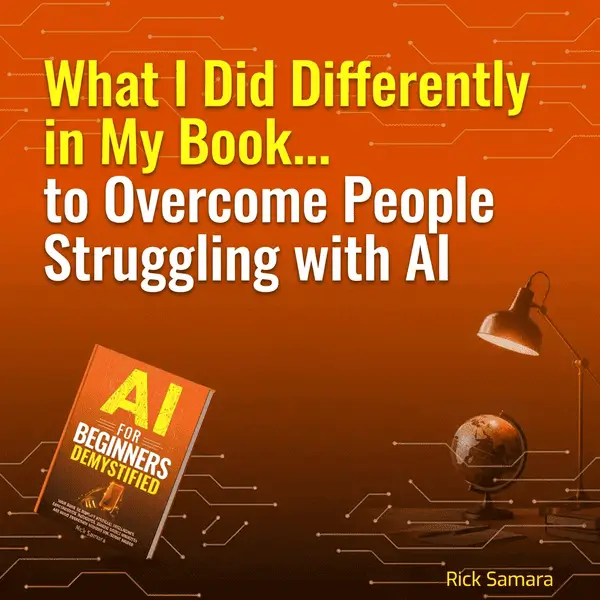
Artificial Intelligence is everywhere, from the tools businesses rely on to the apps people use every day yet for many, it still feels like a black box. Despite the growing number of Books on AI and constant media attention, a large portion of readers in the United States struggle to move from curiosity to true understanding. The problem isn’t a lack of information; it’s that most explanations of AI are built for experts, not for real-world learners trying to make sense of it for the first time.
AI Books for Beginners: Why Most Make AI Feel Harder Than It Is
Walk into any bookstore or search online for AI Books for Beginners, and you’ll find hundreds of options. On the surface, that sounds like a good thing. In reality, it often creates a bigger problem. For a review of the best books on AI, please see: Best Books on AI: The Ultimate Guide to Learning Artificial Intelligence in 2026.
Most AI Basics Books fall into a common trap:
-
- They rely heavily on technical jargon without context
-
- They assume prior knowledge in programming or data science
-
- They prioritize theory over real-world understanding
For beginners, this leads to a frustrating experience. Instead of feeling empowered, readers often feel discouraged before they even finish the first chapter.
The truth is simple: AI isn’t inherently difficult, as it’s often explained.
What new learners really need is a human-centered approach, one that connects AI to everyday experiences, not just code and algorithms.
AI for Beginners Book, The Inspiration Behind My Approach
My perspective on teaching AI didn’t come from academia; it came from real-world experience.
As a former U.S. Air Force Intelligence Analyst, I spent years working with complex systems, analyzing data, and translating highly technical information into clear, actionable insights. In that environment, clarity wasn’t optional it was mission-critical.
That experience shaped how I approach AI education today.
When I started writing my AI for Beginners Book, I had one clear vision:
-
- Make AI understandable for everyone
-
- Remove unnecessary complexity
-
- Focus on clarity, not credentials
Because AI isn’t just for engineers or data scientists, it’s for business owners, professionals, retirees, and anyone trying to navigate a rapidly changing digital world.
About the Book, AI for Beginners Demystified
AI for Beginners Demystified was created to bridge the gap between complexity and comprehension.
Instead of overwhelming readers, the book takes a different approach:
-
- Uses humor and storytelling to explain concepts
-
- Relies on real-life examples instead of abstract theory
-
- Breaks down core ideas into simple, relatable analogies
Key topics include:
-
- Machine Learning: explained as systems that learn from experience, much like humans
-
- Neural Networks: compared to how the human brain processes information
-
- Deep Learning: simplified as layered learning for more advanced decision-making
-
- Generative AI: described through tools people already interact with daily
Rather than diving into equations or code, the focus is on understanding how AI works and why it matters.
This approach makes the book not just informative but accessible.
Artificial Intelligence Books for Beginners, What New Learners Actually Need
If you strip away the noise, beginners don’t need more information; they need better explanations.
From working with clients and readers across the U.S., I’ve found that new learners consistently need three things:
1. Clarity Over Complexity
People don’t need to understand everything about AI; they need to understand the right things first.
2. Reassurance
There’s a growing fear that AI will replace jobs or make skills obsolete. In reality, AI is a tool that enhances human capability, not replaces it.
3. Relevance
Learning sticks when it connects to real-life business workflows, daily routines, or personal productivity.
The best Artificial Intelligence Books for Beginners focus on these principles, not technical depth for its own sake.
Best Books on Artificial Intelligence: What Makes This One Different
There are many New Books On AI, but very few focus on practical application in a way that resonates with everyday readers.
What makes this book different is its foundation in real-world experience:
Business Applications
Examples from my marketing company show how AI improves efficiency, customer engagement, and decision-making.
Everyday Use Cases
From automating tasks to using voice assistants, readers see how AI fits into daily life.
Personal Stories
One of the most powerful moments in the book is introducing my mother to voice technology, demonstrating that AI isn’t just for tech-savvy users.
Balanced Approach
The book combines education, engagement, and storytelling so readers stay interested while they learn.
This isn’t just another theoretical guide; it’s a practical roadmap.
Books About AI for Beginners, Breaking Down Complex Concepts Simply
One of the biggest challenges in writing Books About AI for Beginners is making complex ideas feel approachable without oversimplifying them.
The solution? Context.
Instead of explaining AI in isolation, the book connects concepts to familiar experiences:
-
- Comparing algorithms to decision-making habits
-
- Explaining automation through everyday routines
-
- Using humor to reduce intimidation
This method does two things:
-
- Makes learning more engaging
-
- Builds confidence step-by-step
Because confidence, not intelligence, is the real barrier for most beginners.
Introductory AI Books for Beginners, Why Simplicity Wins Over Complexity
In today’s fast-moving digital economy, waiting to “fully understand” AI before getting started is a mistake.
The most effective Introductory AI Books for Beginners prioritize action over perfection.
Here’s why simplicity wins:
-
- It lowers the barrier to entry
-
- It encourages immediate application
-
- It builds momentum through small wins
More importantly, it helps readers see AI as an opportunity:
-
- A tool for career advancement
-
- A driver of business growth
-
- A way to stay competitive in a changing job market
AI isn’t replacing people, it’s reshaping roles. Those who understand it, even at a basic level, will have a clear advantage.
Final Thoughts: A Beginner-Friendly Path into the World of AI
AI doesn’t have to be intimidating. It doesn’t have to be technical. And it certainly doesn’t have to feel out of reach.
The mission behind AI for Beginners Demystified is simple:
-
- Make AI accessible
-
- Make it practical
-
- Make it human
For readers ready to go further, the book also points to free resources, tools, and learning paths to continue the journey.
Because understanding AI isn’t about mastering complexity, it’s about building confidence.
And once that confidence is in place, everything changes.