The article argues that AI ethics is not about slowing innovation — it’s about creating “Rules of Engagement” for responsible use. The central idea is that AI should be treated as a tool guided by human values, not as an autonomous force beyond control.
In the United States Air Force, we had a saying for every mission: “Check your six, but follow the ROE.” ROE stands for Rules of Engagement. As an Intelligence Analyst, I learned early on that the most powerful tools in the world, whether they are high-altitude surveillance systems or data-crunching algorithms, are only as effective as the ethical framework governing them. Without a clear set of rules, even the most advanced technology can lead to a mission failure.
Today, as we stand in the middle of a massive digital transformation across the U.S. business landscape, Artificial Intelligence (AI) is our new high-tech tool. But many people are looking at the ethical concerns of AI like they’re watching a dystopian sci-fi flick. They see “Terminators” when they should be seeing “Tools.”
The truth is, AI ethics isn’t a futuristic movie plot; it’s about the decisions we make today. Understanding the ethical use of AI is just as vital as learning how to write a perfect prompt. It’s the difference between using a tool that builds your business and using one that inadvertently causes harm.
Why We Need a “Compass” for the Machine
Think of AI as a high-performance co-pilot. In my marketing agency, E-Internet Marketing Services, we use AI to streamline everything from SEO to content strategy. But here’s the thing: a co-pilot is only as good as the instructions and values provided by the pilot that’s you.
The Ethics of AI shouldn’t be viewed as a bureaucratic barrier or a “speed bump” to innovation. Instead, think of it as a roadmap for safety. It ensures that as we move fast, we aren’t driving off a cliff. When we talk about ethics, we are talking about transparency, fairness, and safety.
As I explored in my previous blog, AI Intimidation: Why People Fear AI and Why They Shouldn’t, much of our collective anxiety stems from a lack of boundaries. When we don’t understand how a tool works or what its limits are, we default to fear. Establishing an ethical compass replaces that fear with a structured “Rules of Engagement” for your business and personal life.
Two Major Ethical Concerns of AI (Simplified)
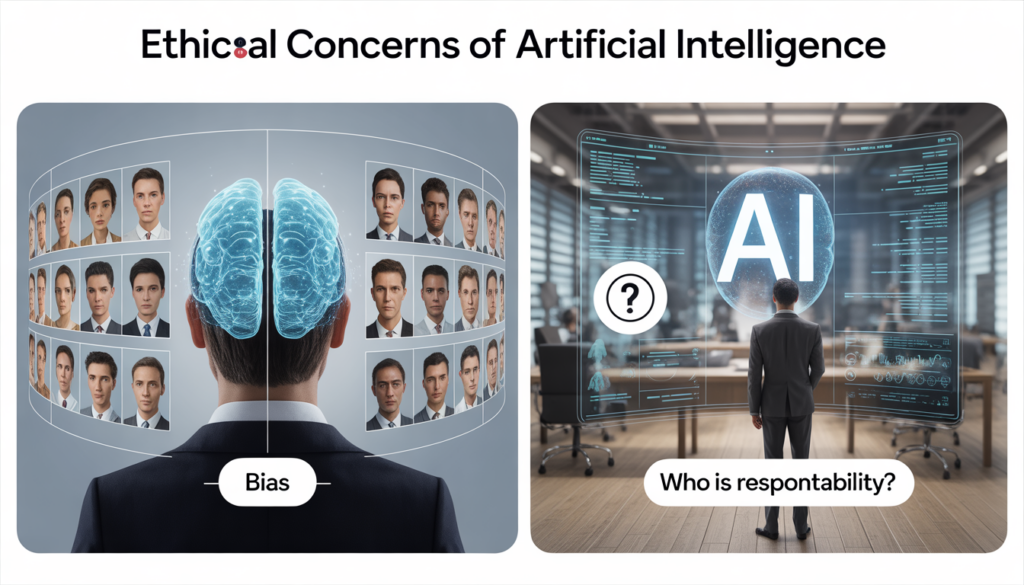
In my AI Basics Book, AI For Beginners Demystified, I make it a point to strip away the “techie” jargon. When it comes to ethics, there are two main areas that every beginner and business owner in the U.S. should understand.
1. Bias: The “Old Dog” Problem
AI doesn’t just “know” things; it learns from data. Think of it like training a puppy. If you only ever show a dog that “mail carriers are bad,” that dog is going to grow up with a bias.
In the AI world, if the data used to train a system is biased (for example, only showing one type of person in leadership roles), the AI will replicate that bias in its results. This is one of the most pressing ethical concerns of AI. We have a responsibility to ensure the data we feed these systems is as diverse and accurate as the real world.
2. Accountability: The “Who’s in Charge?” Problem
I often tell my clients that if an AI tool at my marketing firm generates a strategy that misses the mark or produces factually incorrect information, the AI doesn’t get a “talking to,” I do.
The ethical use of AI hinges on human accountability. You cannot “outsource” your integrity to an algorithm. Whether you are a small business owner or a corporate leader, you remain the “Human-in-the-Loop.” You are the final filter. If the machine malfunctions, the responsibility stops with the person who pressed “Enter.”
Why Beginners Should Care About Ethics First
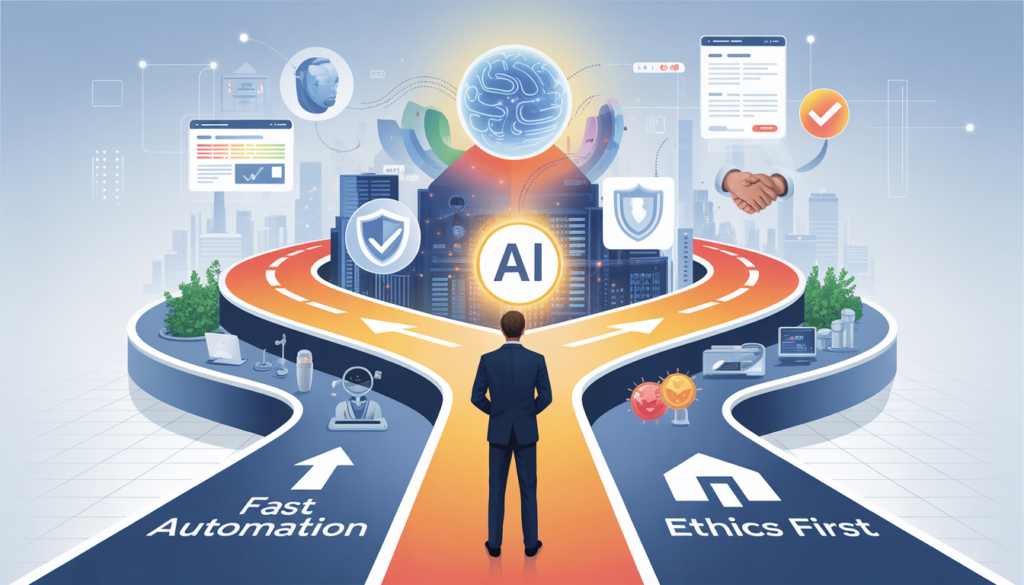
It is tempting to jump straight into the “cool stuff”, generating images, automating emails, or building chatbots. However, starting with ethics builds a foundational “muscle memory” that prevents expensive mistakes later.
In the United States, as digital transformation priorities shift toward responsible innovation, the market is looking for leaders who prioritize trust. The best Ethics of AI books aren’t written just for university philosophers; they are written for everyday practitioners, entrepreneurs, and professionals who want to build a career with integrity.
When you understand the “why” behind the rules, you gain a competitive edge. This foundation is exactly what helps you Build AI Confidence: From Beginner to Practitioner. You aren’t just a user; you are a responsible steward of the technology.
The Rick Samara Approach to Responsible AI
I always go back to a story about my mother. When I gifted her an Amazon Echo, I didn’t just plug it in and walk away. We had a conversation about what it does and, more importantly, what it doesn’t do. We talked about privacy, the “invisible handshake” between us and the tech.
She went from being a skeptic to using voice commands to order her necessities, all because she felt safe and informed. That is the ethical use of AI in action: balancing the “cool factor” with the human need for privacy and boundaries.
This philosophy is the heartbeat of my new AI Basics Book, AI for Beginners Demystified. I wrote this book because I saw a gap in the AI Books market. Most resources were either too technical or too scary. I wanted to create a bridge, a guide that teaches you how to master the technology without losing your human values or your common sense.
Conclusion: Ready to Dive In?
Ethics isn’t about stopping progress; it’s about steering it. Just like my time in the Air Force, success comes down to having a clear mission and the right rules of engagement. By addressing ethical concerns of AI early, you remove the barriers to your own growth.
If you are looking for an AI Basics Book that skips the techie jargon, uses real-world storytelling, and focuses on what actually matters for your life and business, I invite you to pick up a copy of AI for Beginners Demystified.
Remember: Don’t just learn the tech; learn the responsibility that comes with it. The future belongs to those who are both high-tech and high-touch.
Ready to start your journey? Grab your copy of AI For Beginners Demystified here, and let’s turn that AI intimidation into AI confidence.
About the Author
Rick Samara is an author, consultant, and AI educator focused on helping individuals and small businesses understand and adopt artificial intelligence responsibly. Drawing from his background in military intelligence and business leadership, he translates complex AI concepts into practical, approachable insights that empower readers to use emerging technologies with confidence and integrity. His work emphasizes ethical AI adoption, human-centered innovation, and real-world strategies for navigating the rapidly evolving digital landscape.
Further Reading
- European Commission – Ethics Guidelines for Trustworthy AI
European Commission. (2019). Ethics guidelines for trustworthy AI. European Commission. - NIST AI Risk Management Framework
National Institute of Standards and Technology. (2023). Artificial intelligence risk management framework (AI RMF 1.0). U.S. Department of Commerce. - IBM – What is AI Ethics?
IBM. (2024). What is AI ethics? IBM Think. - Harvard Business Review – Ethical Machines
Harvard Business Review. (2019). Ethical machines. Harvard Business Review. - World Economic Forum – Responsible Use of AI
World Economic Forum. (2024). Responsible AI principles businesses should follow. World Economic Forum. - MIT Sloan – Why Responsible AI Matters
MIT Sloan School of Management. (2023). Responsible AI has become a business imperative. MIT Sloan Management Review. - UNESCO Recommendation on the Ethics of Artificial Intelligence
UNESCO. (2021). Recommendation on the ethics of artificial intelligence. UNESCO. - Stanford HAI – Responsible AI Resources
Stanford Human-Centered Artificial Intelligence. (2024). Responsible AI resources. Stanford University.