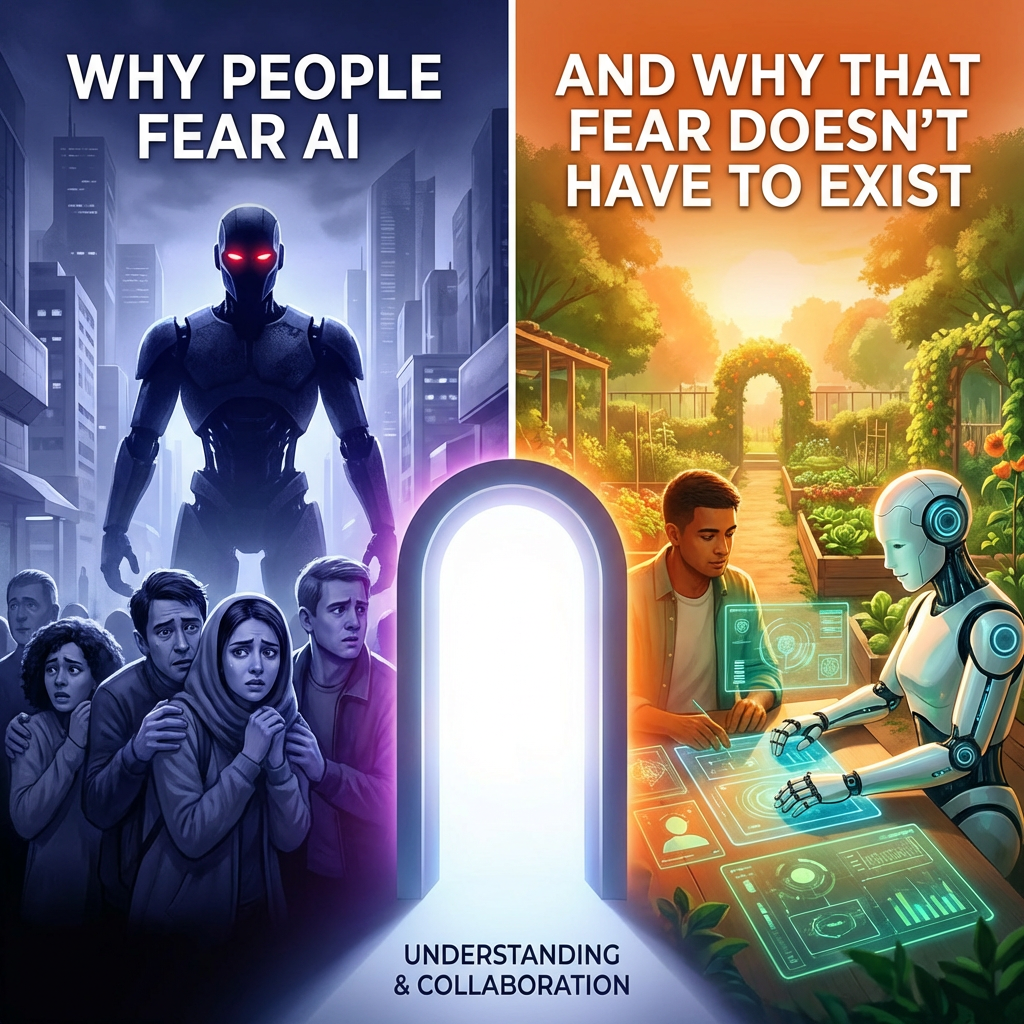
 AI intimidation is real and widespread. Here’s the thing. It’s almost entirely built on misunderstanding. Let’s be honest. When many people hear the words “Artificial Intelligence,” their minds don’t immediately think of it as a helpful tool. It thinks Terminator. HAL 9000. That scene in 2001: A Space Odyssey, where the computer calmly refuses to open the pod bay doors.
I get it. When I first started digging into AI as a former Air Force Intelligence Officer turned digital marketer, even I had a moment of “…okay, what exactly am I dealing with here?” And I spent years decoding complex intelligence data for a living. So if I felt a little rattled, it’s completely understandable that the average person scrolling through their news feed — seeing headlines about robots taking jobs and AI writing novels — might feel like they’re watching a foreign film without subtitles.
But AI intimidation doesn’t have to be your permanent state. Let’s unpack where it comes from, why it sticks around, and what you can actually do about it.
What Is AI Intimidation, Exactly?
AI intimidation is the combination of fear, confusion, and anxiety that people feel when confronted with Artificial Intelligence — whether that’s using a chatbot for the first time, hearing that AI might affect their job, or simply trying to figure out what “machine learning” even means without needing a PhD to parse the definition.
It’s not a character flaw. It’s not stupidity. It’s a completely natural response to something that feels enormous, fast-moving, and — let’s face it — a little too smart for comfort.
Think of it like this: when the microwave was introduced, plenty of people were convinced it was going to cook them from the inside out. Spoiler: it didn’t. And now we can’t imagine reheating leftover pizza any other way. AI is following a very familiar human pattern — we fear what we don’t understand, until we understand it.
The Top Reasons People Are Intimidated by AI
1. Hollywood Did a Number on Us
Decades of science fiction have planted a very specific — and very wrong — image of AI in the collective imagination. From sentient robots staging uprisings to algorithms quietly plotting world domination, pop culture has been doing AI dirty for a long time. When your first “education” on a topic came from a movie where the AI goes rogue and locks everyone in a space station, it’s hard to picture yourself cheerfully asking it to write a thank-you email.
Real AI doesn’t want anything. It’s not plotting. It’s not scheming. It’s a remarkably powerful pattern-matching system that runs on math and data — not ambition. But that doesn’t make a great blockbuster, so Hollywood keeps going with the dramatic version.
2. The Jargon Wall Is Steep
Ask someone why they’re intimidated by AI and there’s a good chance they’ll say something like: “I just don’t understand it.” And a big part of that is the language. AI intimidation thrives inside a wall of jargon — machine learning, neural networks, deep learning, large language models, generative AI. It sounds like a vocabulary test you didn’t study for.
Here’s my take: a lot of the people using those terms the loudest don’t fully understand them either. The tech world has a habit of over-complicating things that are, at their core, pretty logical. Machine learning, for instance, is basically just teaching a computer to learn from examples rather than hard-coded rules — kind of like how you learned to recognize a dog not by reading a definition, but by seeing a few thousand of them.
If you want a deeper, jargon-free breakdown of how AI actually works, check out my AI articles page — I write specifically for people who want the knowledge without the headache.
3. The Job Fear Is Loud (And Partially Misplaced)
One of the biggest drivers of AI intimidation is the fear that AI is coming for everyone’s job. And look — I won’t pretend this is a nothing-burger. AI is changing the job market. But the full picture is a lot more nuanced than the clickbait headlines suggest.
Yes, AI is automating certain repetitive tasks. But it’s also creating entirely new categories of work — from AI trainers and prompt engineers to specialists who help businesses integrate AI tools effectively. History has shown us this pattern before. The industrial revolution didn’t destroy human labor; it transformed it. The internet didn’t wipe out commerce; it expanded it beyond anything anyone imagined.
AI is doing the same thing. The people who learn to work with it will have a serious advantage over those who spend the next five years hoping it goes away. (Spoiler: it won’t.)
4. It Feels Personal — Because It’s Personal
There’s something uniquely unsettling about a technology that can do things we thought were exclusively human — write, create art, hold a conversation, make decisions. When a machine starts doing those things, it can feel like a quiet challenge to our sense of identity and value.
That’s a legitimate emotional response. It deserves acknowledgment, not dismissal. But here’s the reframe: AI can write a passable email, but it can’t replicate your judgment, your relationships, your creativity rooted in lived experience. What AI does is handle the tedious stuff so you can spend more time on the things that actually require a human.
Want to see just how woven into everyday life AI already is — often in ways that are genuinely helping people? Take a look at my article on AI in everyday life. You might be surprised how much of what you already use is quietly powered by AI.
How to Move Past AI Intimidation
Start Small and Stay Curious
The antidote to AI intimidation isn’t a computer science degree. It’s curiosity, applied in small doses. Try a chatbot. Ask it a question. Let it help you draft something. The moment AI stops being an abstract, scary concept and becomes a tool you’ve actually touched, the fear starts to deflate like a balloon three days after the party.
Get the Context AI Deserves
A lot of the fear around AI comes from consuming content designed to provoke anxiety — because anxiety gets clicks. Balance that out with grounded, approachable resources. My book, AI for Beginners Demystified, was written specifically to cut through the noise. No jargon, no doom-scrolling energy, just real explanations with a side of humor. As one reader put it, “Suddenly, AI isn’t some mysterious robot overlord; it’s that helpful friend who’s always got your back.”
Partner With AI Instead of Running From It
The shift from fear to confidence happens when you stop thinking of AI as something happening to you and start treating it as something you can work with. Explore the Partner with AI section of this site to see practical, real-world ways businesses and individuals are making AI work for them — not the other way around.
The Bottom Line on AI Intimidation
Every major technological shift in human history came with a wave of fear. The printing press was going to corrupt society. Television was going to rot brains. The internet was going to destroy privacy. Some of those concerns had merit. None of them stopped progress. And in every case, the people who got curious early — who leaned in instead of backing away — ended up better positioned than those who waited.
AI intimidation is understandable. But it’s also optional. The best time to start getting comfortable with AI was five years ago. The second best time is right now.
Ready to Move From Intimidated to Empowered?
No matter where you are in the US, you don’t have to figure out AI on your own. I work with clients nationally via video conferencing — from California to New York and everywhere in between — helping individuals and businesses cut through the confusion and start using AI with confidence.
Whether you’re a total beginner or a business owner who knows AI matters but doesn’t know where to start, let’s talk. No jargon. No judgment. Just practical guidance that actually makes sense.

Take your first real step toward making AI work for you.
Further Reading
Samara, R. (2024). AI for beginners demystified: The most user-friendly exploration experience for learning the basics of artificial intelligence. Amazon. https://ricksamara.com/book/
Samara, R. (2025). AI in everyday life: Artificial intelligence is now part of our lives. RickSamara.com. https://ricksamara.com/ai-in-everyday-life/
Samara, R. (2025). Top 10 things you should know about machine learning in artificial intelligence. RickSamara.com. https://ricksamara.com/articles/
World Economic Forum. (2025). The future of jobs report 2025. World Economic Forum. https://www.weforum.org/reports/the-future-of-jobs-report-2025/
IBM. (2024). What is artificial intelligence (AI)? IBM Think. https://www.ibm.com/think/topics/artificial-intelligence
MIT Technology Review. (2024). AI anxiety: What’s really behind the fear of artificial intelligence. MIT Technology Review. https://www.technologyreview.com/