Why This Matters for Beginners
This article is about multimodal content creation in practice. If you’re just starting with AI, here’s the good news: you don’t need to master everything at once. My book, AI for Beginners Demystified, set the foundation. Now, it’s time to extend your knowledge in AI to help you keep up with this amazing technology. Furthermore, this article will provide instructions on how actually to put multimodal content into practice. I hope you enjoy the experience!
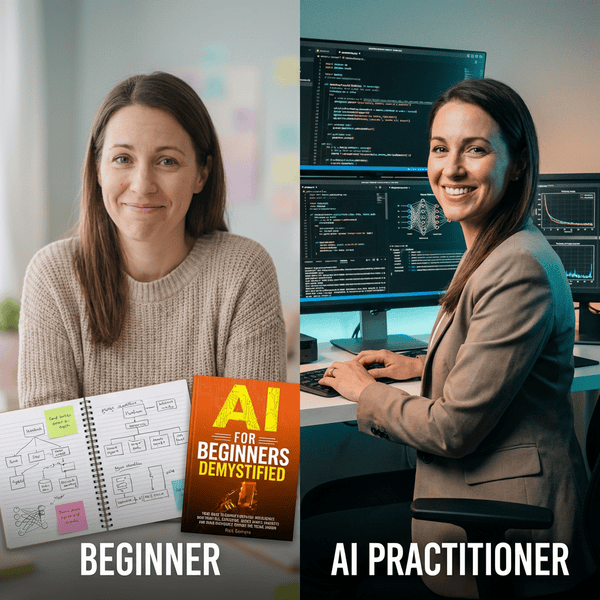
Multimodal content in practice is powerful because it allows you to transition from an AI Beginner to an actual practitioner and:
1. Repurpose Content Without Starting Over
You write one article. AI helps you transform it into five pieces of content. That’s efficiency. And, its about working smarter, not harder.
2. Learn by Experimenting
You can test:
- “What does this look like as a video?”
- “Can this become a voice script?”
- “Can I turn this into an infographic?”
AI lets you explore formats without expensive tools or complicated software.
3. Build Confidence Faster
When you see your idea turned into multiple formats in minutes, you realize something important: you’re not “bad at tech.” You just needed the right tools and how to properly use them. We will use ChatGPT as our tool.
Confidence grows when results show up.
A Simple Beginner Workflow: Instructions on how to actually put multimodal content into practice
Start here:
Step 1: Write a short article (500 words).
Ask AI to help you structure it clearly. Follow these instructions…
For example, here is a prompt I use vey successfully:
PROMPT:
Write a blog post using this focus keyword, XXXXX XXXXX XXXXX. Use my voice and tone, and add a bit of humor. Keep it under 500 words. Explain it for someone just starting to experiment with AI. Follow APA style and include a Further Reading section at the bottom of the article with ‘dofollow’ links to recommendations. Create a Meta title and description for SEO purposes.
Note: The above example uses severat pillars of a successful prompt. The first and most important is the task or action you want ChatGPT to take; Write a blog post using this focus keyword, XXXXX XXXXX XXXXX. The XXXXs represent a three-word keyword phase that we want to write about. In fact, the keyword string we used is Multimodal Content Creation. That’s how we created this entire article.
For our purpose here, just use the keyword string you might want to write about. Keep the same constraint, under 500 words. The next phrase is the Persona or Role. We used Explain it for someone just starting to experiment with AI. This tells ChatGPT who it should be acting as, and sets the tone and expertise level. If you feel comfortable changing the Persona, feel free to do so. Keep the rest of prompt as it is.
Go ahead and let ChatGPT write the article for you. Then we will move on to the next step.
Once you have the article, feel free to move on to Step 2 and Step 3.
Step 2: Turn it into 5 social media posts.
Different angles. Same core message.
Step 3: Create one simple graphic.
Use AI to generate an image that matches your message.
You just created multimodal content without hiring a production team.
That’s not futuristic. That’s practical.
Why Businesses Should Care
Multimodal content creation levels the playing field.
Small businesses can now:
- Compete visually with larger brands
- Maintain consistent messaging
- Publish more often without burnout
- Stretch marketing budgets further
In a world where attention is fragmented, showing up in multiple formats increases visibility. Some people prefer reading. Others watch. Others listen.
When your message exists in all three? You multiply your reach.
But Use It Intentionally
AI can generate a lot of content quickly. That doesn’t mean you should publish everything it produces.
Ask:
- Does this align with my brand?
- Is this clear and helpful?
- Would I stand behind this message?
Multimodal content creation works best when you guide it. AI is the assistant. You’re still the decision-maker.
The Bigger Picture
We’re moving into an era where communication is no longer single-channel. Text-only strategies are fading. Visual and audio engagement are becoming standard.
Learning multimodal content creation now positions you ahead of the curve.
You don’t need to become a tech expert.
You need to become comfortable experimenting.
Start small. Stay consistent. Improve intentionally.
And remember: AI is not replacing your creativity. It’s amplifying it.
And that’s a powerful place to be. I mention in my book, AI for Beginners Demystified, that my readers should continue their education in AI. I cite many good sources for continuing education. So, I practice what I preach. I’ve completed six certification courses. However, I have found that some courses are somewhat outdated. With AI Technology moving so fast, I believe the only true way to keep up is through Practice, Practice, and more Practice. Practice removes the friction between your idea and its execution.
About the Author
Rick Samara is an author, consultant, and AI strategist who helps businesses and creators understand how emerging AI technologies can improve communication, marketing, and productivity. With a focus on practical implementation, he specializes in translating complex AI concepts—such as multimodal systems, generative AI, and automation—into clear, actionable insights for everyday use. Drawing on experience in leadership, technology, and intelligence analysis, Rick’s work emphasizes responsible innovation, human-centered design, and helping organizations adapt confidently to the future of AI-driven content creation.
Further Reading
Brynjolfsson, E., & McAfee, A. (2014). The second machine age: Work, progress, and prosperity in a time of brilliant technologies. W. W. Norton & Company. https://wwnorton.com/books/the-second-machine-age/
OpenAI. (2023). GPT-4 technical report. https://openai.com/research/gpt-4
Stanford University. (2024). AI Index Report 2024. Stanford Institute for Human-Centered Artificial Intelligence. https://aiindex.stanford.edu/report/
World Economic Forum. (2023). The future of jobs report 2023. https://www.weforum.org/reports/the-future-of-jobs-report-2023/
McKinsey & Company. (2023). The economic potential of generative AI. https://www.mckinsey.com/capabilities/quantumblack/our-insights/the-economic-potential-of-generative-ai-the-next-productivity-frontier