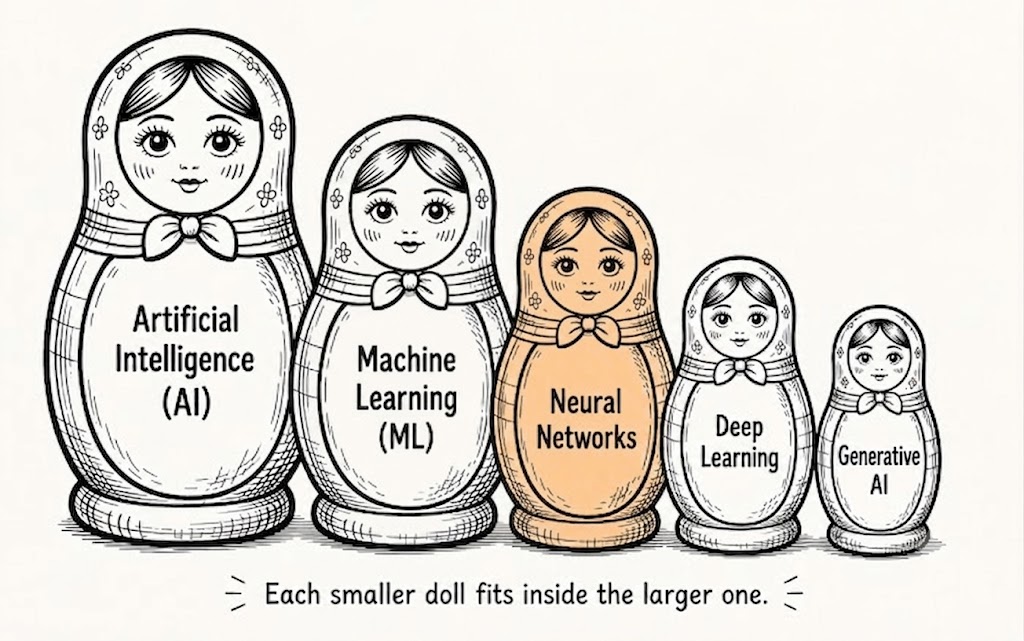
This article will unravel the mystery of neural networks for beginners. Neural networks are one of the most talked-about topics in artificial intelligence. For beginners, the concept can seem abstract or overly technical. In truth, neural networks are machine learning models designed to mimic the complex functions of the human brain. They are a set of algorithms, loosely modeled after the brain, designed to recognize patterns. This guide on neural networks for beginners breaks them down into simple pieces, using real-life examples that show how they work in everyday technology.
Assuming you are new to Artificial Intelligence, I recommend reading my article AI Basics for Beginners: Your First Step to Understanding Artificial Intelligence. You will also find my article on Machine Learning a handy, informative companion to this one.
Neural Networks for Beginners: What Is a Neural Network?
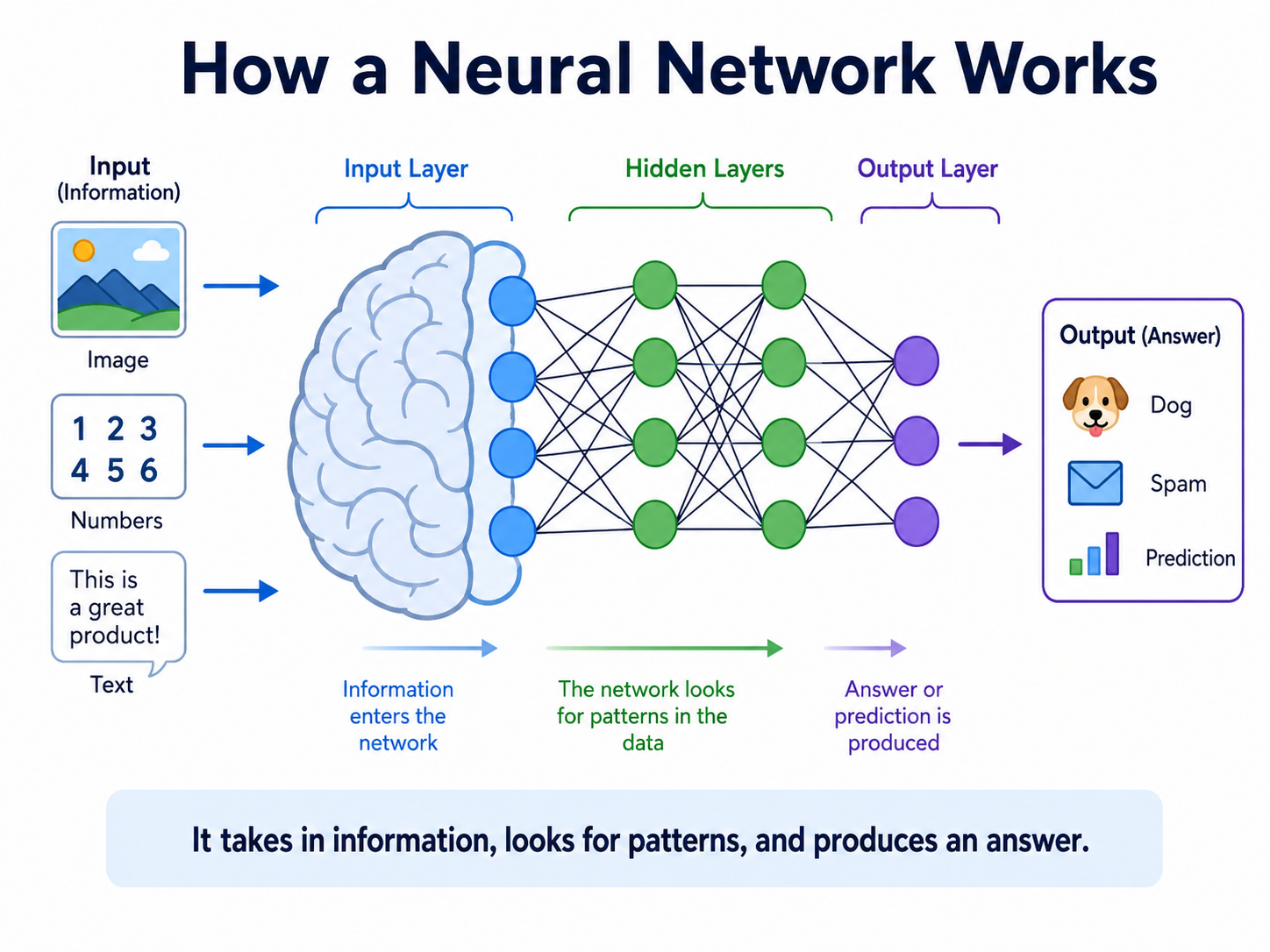
A neural network consists of interconnected nodes, often called neurons, that process data. These neurons are organized into layers: an input layer, one or more hidden layers, and an output layer. The network learns patterns from data and can then perform tasks such as pattern recognition and decision making. Think of it as a system that finds nonlinear patterns in information, which traditional linear methods might miss.
Each neuron receives inputs, multiplies those inputs by assigned weights, adds a bias, and then passes the result through an activation function. This is already getting too complicated for me! The activation function introduces non-linearity. One common activation function is the sigmoid function, which outputs a number between 0 and 1. This output can represent a probability or a decision boundary. The process of moving inputs forward through the network to produce an output is called feedforward.
Neural Networks for Beginners: How Does a Neural Network Work? A Step-by-Step Look
To understand neural networks, it helps to walk through the basic operations inside a single neuron and across layers.
Forward Propagation
Forward propagation is the method the network uses to compute outputs. It begins with the input layer receiving raw data, such as image pixel values or numerical features from a dataset. Each input is multiplied by a weight, and a bias is added. The weighted sum is then passed through an activation function. This process repeats through each hidden layer until the output layer produces the final result. This explanation may sound a bit complicated, but it’s the easiest way to describe neural networks for beginners.
The entire sequence is a linear transformation (a weighted sum plus a bias) followed by a nonlinear activation function. For a basic neural network, you can implement this from scratch in Python using NumPy. A great source on neural networks for beginners, such as Victor Zhou’s blog, https://victorzhou.com/blog/intro-to-neural-networks/ assumes no prior machine learning knowledge, making it accessible to newcomers.
Neural Networks for Beginners: Real-Life Example: Email Spam Detection
One of the most common real-life applications of neural networks is spam detection. Email services use neural networks to recognize patterns in messages and classify them as spam or not spam. The network takes input features such as the frequency of certain words, the sender’s address, and the time the email was sent. Through forward propagation, it computes a score. If the score is above a threshold, the email is labeled spam.
During training, the network adjusts its weights to minimize the error between its predictions and the actual labels. This process is done using backpropagation, which calculates gradients and updates the weights. Over thousands of examples, the network learns optimal feature combinations, including nonlinear interactions between words and sender behavior, to make accurate predictions.
Neural Networks for Beginners: Real-Life Example: – Handwritten Digit Recognition
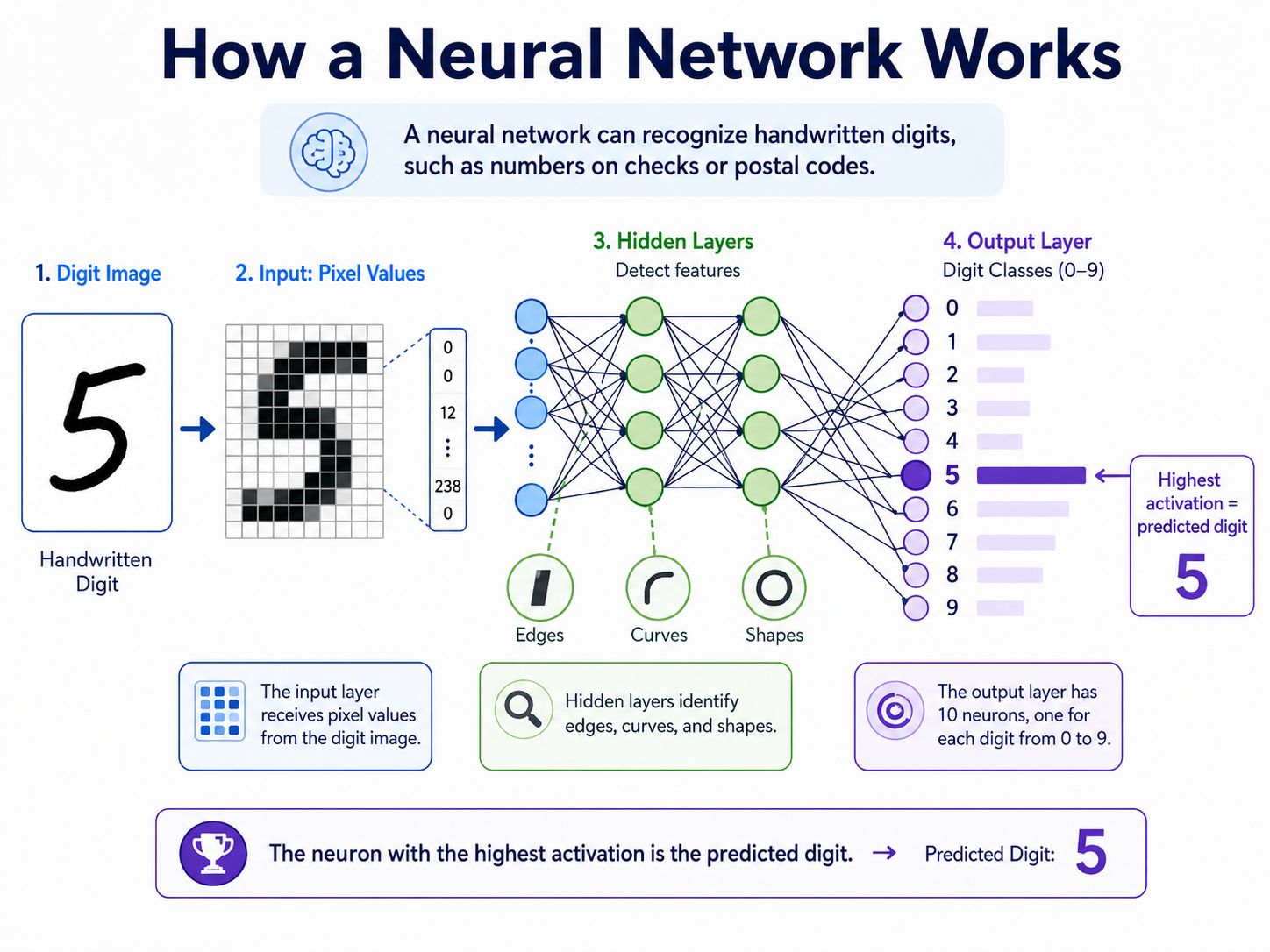
Another classic example is recognizing handwritten digits, such as the numbers on a check or a postal code. A neural network takes the pixel values of a digit image as inputs. The network processes this data through hidden layers, recognizing edges, curves, and shapes. The output layer has ten neurons, each representing a digit from 0 to 9. The neuron with the highest activation indicates the predicted digit.
This type of pattern recognition is a hallmark of neural networks. By learning from a dataset of labeled digits, the network discovers non-linear patterns that distinguish a “4” from a “9” even when handwriting varies. This is the same technology behind many modern optical character recognition systems. In the following example, I’ll use the number 5.
Neural Networks for Beginners: Real-Life Example – Recommendation Systems
Streaming services and online retailers use neural networks to recommend products or content. The network examines your past behavior, such as movies you have watched or items you have purchased, as well as the behavior of similar users. It finds nonlinear patterns in that data to predict what you might like next.
For instance, a recommendation system might notice that people who watch animated films also tend to watch documentaries. A neural network can capture that combination without being explicitly programmed to look for it. The network automatically learns optimal feature cross-products during training to minimize prediction loss, often making suggestions that feel surprisingly accurate.
Neural Networks for Beginners: How Do Neural Networks Learn? Training and Backpropagation
Training a neural network involves two main phases: forward propagation and backpropagation. In forward propagation, the network makes a prediction. In backpropagation, the network calculates the error of the prediction and propagates it backward through the layers. This allows the network to adjust the weights and biases to reduce future errors.
The goal of training is to minimize a loss function, which measures how far the network’s predictions are from the true values. Over many iterations, the weights converge to values that produce accurate outputs. The network does not just memorize data; it learns general patterns so it can make predictions on new, unseen data.
Okay. That is way too complicated. Here is a much simpler explanation and one that best fits this article on neural networks for beginners:
The Cake-Baking Analogy
Imagine your grandmother is teaching you how to bake her famous chocolate cake, but she cannot look over your shoulder while you make it.
The Forward Pass (Baking): You follow the recipe, mix the ingredients, bake the cake, and hand her a slice to taste.
The Loss Function (The Taste Test): She takes a bite and judges it. She tells you, “It is too dry, too salty, and not sweet enough.” This feedback is the “error.”
Backpropagation (Fixing the Recipe): To fix the next cake, you trace your steps backward through the recipe to find what caused those specific errors:
Too dry? You realize you left it in the oven for 5 minutes too long.
Too salty? You accidentally used two teaspoons of salt instead of one.
Not sweet enough? You did not pack the brown sugar tightly.
The Update: You write down adjustments next to those specific steps so you do not make the same mistakes next time.
Frequently Asked Questions: Neural Networks for Beginners
Do I need to be a math expert to learn neural networks?
No. While some algebra and basic calculus are helpful, many beginner-friendly tutorials explain the math in simple terms. You can start with a tutorial that assumes no prior machine learning knowledge, such as Victor Zhou’s blog, and gradually build your understanding.
What programming language should I use to build neural networks?
Most examples are written in Python, and it is the most accessible language for beginners. You can use libraries like NumPy to implement a network from scratch, or later try frameworks like TensorFlow or PyTorch after mastering the basics.
How long does it take to learn neural networks for beginners?
There is no fixed timeline. Some beginners grasp the core concepts in a few days with daily practice. Others take several weeks. The key is to build projects and experiment with real data rather than just reading theory.
Are neural networks the same as the human brain?
No. Neural networks are loosely modeled after the brain, but they are far simpler. They mimic certain functions, such as processing information through interconnected nodes, but they do not replicate the full complexity of biological neurons.
Can I build a neural network without understanding deep learning?
Yes. After all, this article is on neural networks for beginners. You can start with a simple network that has one hidden layer and learn how forward propagation and backpropagation work. This foundation will make it easier to understand deep learning later, when you add more layers and complex architectures. For now, keep it as simple as possible. That is what neural networks for beginners is all about.
Neural networks are a powerful tool for pattern recognition and decision making, and they are already woven into many everyday technologies. By understanding the basic components and seeing them in real-world examples such as spam detection, digit recognition, and recommendations, you can demystify this technology and take your first steps toward using it yourself.
Author Bio

Rick Samara is the award-winning author of AI for Beginners Demystified and president of E-Internet Marketing Services LLC. A former Air Force intelligence officer, Rick specializes in turning complicated technology into practical information that beginners and small-business owners can understand.
His writing uses plain language, real-life examples, and a little humor to help readers explore artificial intelligence with greater clarity and confidence. His approach to neural networks for beginners is simple: explain the idea first and introduce the technical details only when they become useful.
Where Can You Learn More About Neural Networks?
Google for Developers. (n.d.). Neural networks. Machine Learning Crash Course.
IBM. (n.d.). What is a neural network?.
Smilkov, D., & Carter, S. (n.d.). A neural network playground. TensorFlow.
TensorFlow. (2024, August 16). TensorFlow 2 quickstart for beginners. Google.