
Why the Value of AI Certifications Is Rising So Quickly?
AI is no longer a “nice bonus skill.” It’s becoming a baseline expectation. Job descriptions quietly add “AI skills preferred,” managers expect AI-assisted productivity, and employers increasingly reward candidates who can prove they know what they’re doing. That’s where the value of AI certifications becomes clear: they turn curiosity into credibility.
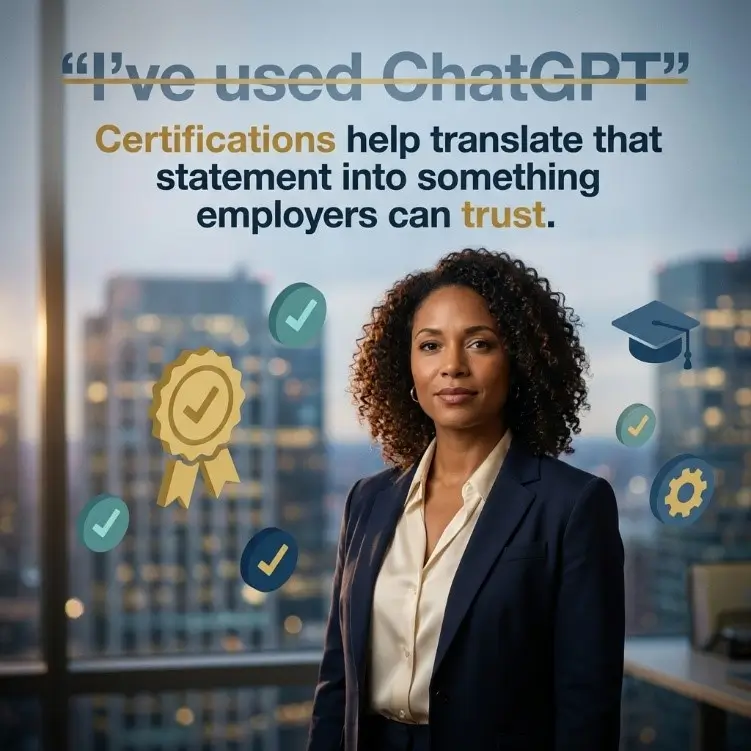
In plain terms, saying “I’ve used ChatGPT” is no longer enough. Certifications help translate that statement into something employers can trust.
AI Skills Are Now a Baseline, Not a Differentiator
Multiple workforce studies show that even as overall tech hiring fluctuates, demand for AI-related skills continues to grow. Employers are explicitly prioritizing candidates with AI capabilities, sometimes even over years of experience. In fact, a majority of business leaders report they would choose a less-experienced candidate if that person demonstrates strong AI skills. This shift matters. Walking into an interview without demonstrable AI capability doesn’t make you behind—it makes you invisible.
Why Certifications Matter in This Environment
AI certifications transform informal learning into structured, validated skills. They signal that you didn’t just experiment—you followed a curriculum, completed assessments, and learned how AI actually applies to real work.
Employers Are Paying More for Certified AI Skills
AI skills don’t just improve employability; they increase compensation. Research shows that many AI-related certifications and skills command salary premiums ranging from single digits to double digits. That’s not motivational fluff—it’s math.
From a career standpoint, AI certifications serve as a form of income protection. They help safeguard earning potential as AI reshapes roles across industries.
AI Demand Extends Beyond Technical Roles
AI isn’t only for data scientists and engineers. Employer demand for AI skills is rising across marketing, operations, HR, finance, and management roles. At the same time, most employees using AI tools receive little or no formal training.
This gap is where AI certifications shine. They convert ad hoc tool use into demonstrable competence, giving professionals a measurable edge in performance reviews, promotions, and job searches.
How AI Certifications Help You Stay Competitive
They Formalize Skills You’re Already Learning
Self-study is valuable, but employers can’t verify YouTube playlists or clever prompts. Certifications provide structure, hands-on practice, and proof, something hiring managers can actually evaluate.
They Differentiate You in a Crowded Market
Many candidates claim AI skills. Fewer can back it up. Certifications from recognized providers signal commitment, discipline, and baseline competence, qualities employers consistently value.

They Help Future-Proof Your Role
AI may not replace your job, but someone who knows how to use AI better might. Certifications help keep you on the right side of that equation by demonstrating your ability to adapt as tools and workflows evolve.
Types of AI Certifications and What They Signal
Foundational AI and “AI for Everyone” Programs
These certifications focus on AI literacy rather than coding. They cover core concepts, generative AI, ethical considerations, and business applications. Ideal for non-technical professionals who need to speak intelligently about AI without pretending they’re machine learning engineers.
Platform-Specific Certifications (Azure, AWS, Google)
Cloud-based AI certifications signal that you can work inside real enterprise ecosystems. They demonstrate to employers that you understand deployment, monitoring, and responsible AI, not just theory.
Machine Learning and Deep Learning Specializations
These programs dive deeper into models, data, and trade-offs. They’re more demanding, but they clearly signal technical depth for those pursuing AI engineering or data science paths.
Choosing the Right AI Certification for Your Goals
Start with your current role and target role, not a generic “Top 10” list. Look at job postings, LinkedIn profiles, and employer requirements. Choose certifications that align with real hiring signals, are widely recognized, and reflect modern AI tools—not outdated theory.
Conclusion: The Real Value of AI Certifications
The value of AI certifications isn’t that they guarantee promotions or six-figure salaries. It’s that they:
- Convert curiosity into verified skills
- Differentiate yourself in a noisy job market
- Support higher earning potential
- Help you stay relevant as AI reshapes work
AI rewards those who invest in learning it. Certifications make that investment visible.
Sources
American University Kogod School of Business. (2025). The value of adding an AI certification to your resume.
https://kogod.american.edu/news/the-value-of-adding-an-ai-certification-to-your-resume
Federal Reserve Bank of Atlanta. (2025). Measuring employer demand for AI skills.
https://www.atlantafed.org/cweo/workforce-currents
Forbes. (2024). 71% of employers prefer AI skills over experience.
https://www.forbes.com/sites/rachelwells/2024/11/05/71-of-employers-prefer-ai-skills-above-experience-in-2024/
Network World. (2025). AI certifications outpace non-certified AI skills in pay growth.
https://www.networkworld.com/article/4073963/ai-certifications-outpace-non-certified-ai-skills-in-pay-growth.html
Microsoft Learn. (2025). Microsoft Certified: Azure AI Engineer Associate.
https://learn.microsoft.com/en-us/credentials/certifications/azure-ai-engineer/