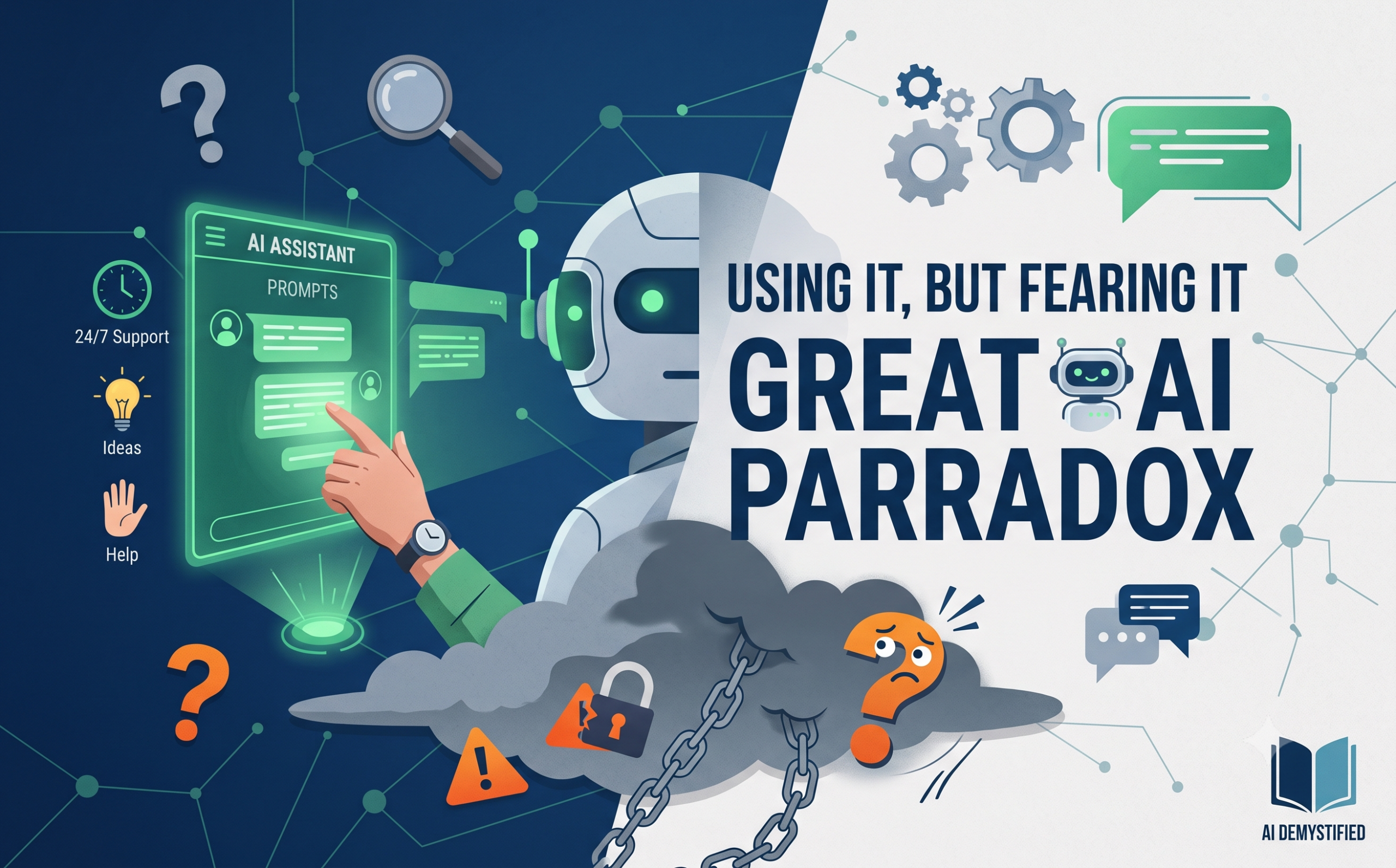
The Great AI Paradox is real. Artificial intelligence has seamlessly transitioned from science fiction into our daily routines, powering everything from web searches to automated customer service. Yet, an intriguing phenomenon has emerged: the great AI paradox. The great AI paradox describes a unique social tension in which public adoption of chatbots grows exponentially, yet underlying fear, doubt, and skepticism remain at an all-time high. While users actively rely on generative AI tools to draft emails, answer questions, and streamline workplace efficiency, they simultaneously harbor deep concerns about data privacy, job security, and algorithmic accuracy. Understanding the great AI paradox is key to navigating our evolving digital future.
The Great AI Paradox: Why Are People Skeptical of AI Chatbots While Actively Using Them?
The great AI paradox flourishes because personal utility often conflicts with societal anxiety. Studies show that while over 70% of adults have experimented with generative AI, around half feel significantly more concerned than excited about its rise.
This friction stems from three main drivers:
- Accuracy Concerns and “Hallucinations”: AI models frequently produce false information presented as absolute fact. Users who encounter these errors quickly learn to distrust the technology for high-stakes tasks.
- Fear of Job Displacement: Between 60% and 70% of workers worry that widespread chatbot automation will result in massive net job losses across administrative, creative, and technical sectors.
- Loss of Human Connection & Bias: As algorithms begin handling customer interactions and content creation, concerns linger regarding data privacy, algorithmic bias, and the erosion of genuine human engagement.
People use these tools out of practical necessity, yet remain cautious of their broader implications.
How Are Everyday Users Learning to Overcome AI Hesitancy?
Despite persistent anxiety, users are actively attempting to “demystify” artificial intelligence rather than avoid it. Embracing conversational tools has become a vital skill in the modern world. To overcome the learning curve without being overwhelmed by technical hurdles, everyday users are adapting in several key ways:
1. Overcoming the Great AI Paradox: Shifting Toward Prompt Engineering
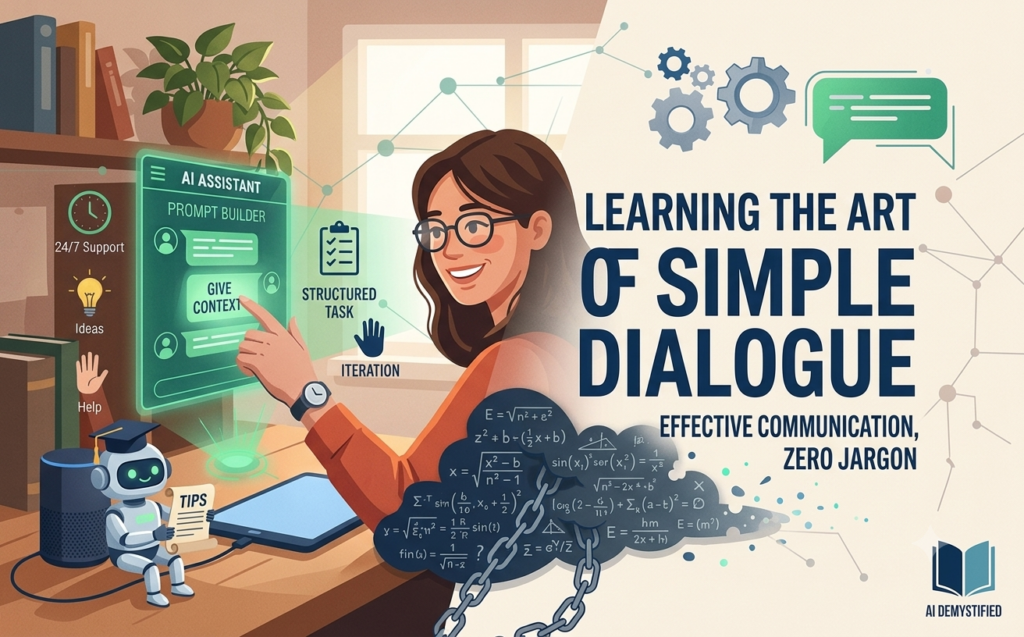
Users are moving away from traditional search engine habits, like typing short keywords, and adopting conversational prompting. By providing context, assigning personas to chatbots, and engaging in iterative dialogue, people are discovering how to produce far more accurate results.
This is a process that takes time and practice to provide the right input and get the output you desire. However, here is a simple framework to follow (Source: Vale, A. (2025). The Prompt Recipe: A Practical Guide to Prompt Engineering and AI Interaction. Independent.):
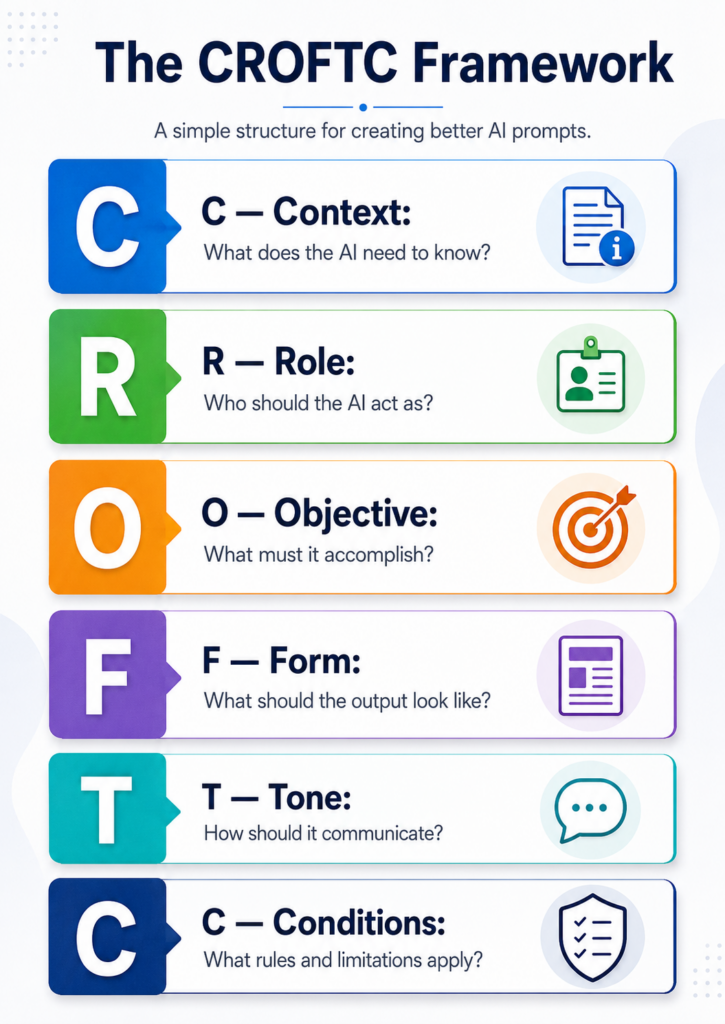
Let me provide an example that can be used for virtually any scenario:
Let’s look at how a father organizing a neighborhood bowling league can apply the CROFTC framework to write a clear, effective prompt:
[Context] 🎳 I am organizing a 10-week, 8-team recreational bowling league for local parents starting next month.
[Role] Act as an experienced, highly organized community sports league coordinator.
[Objective] Draft a welcome email for team captains that outlines the schedule format, rules, and fee details.
[Form] Format the output with clear bullet points, bold headers, and a simple placeholder schedule table.
[Tone] Friendly, encouraging, and structured, with a lighthearted, welcoming vibe.
[Conditions] Keep the email under 300 words, explicitly state that all skill levels are welcome, and highlight that fees are due by next Friday.
By breaking the prompt down this way, the AI receives every boundary it needs to generate a ready-to-use email without needing multiple revisions.
2. Overcoming the Great AI Paradox: Bridging the “Tech Jargon” Gap
As highlighted in my book, AI for Beginners Demystified, the primary barrier for most individuals isn’t the technology itself. It is intimidating jargon. When complex topics like Machine Learning or Deep Learning are explained through plain-language analogies rather than textbook formulas, beginner confidence soars.
3. Overcoming the Great AI Paradox: Practical Workplace Integration
Rather than designing complex custom systems, small businesses and independent professionals are implementing friction-free solutions. Tools like 24/7 Voice AI phone assistants, automated appointment schedulers, and basic customer service chatbots showcase how simple tools can boost efficiency without replacing human strategy.
Conclusion
I have to say these results are not surprising. As I continue my journey to simplify AI for anyone interested in learning, I still find most courses and books overly complicated. It’s like that guy I knew when I was growing up. He talked a good game, but he had very little substance. There are hundreds of so-called experts willing to teach some of the more sophisticated aspects of AI that the chatbots can perform. Do a YouTube search, and you’ll know what I mean. Yet, there remains a huge divide between effectively using the chatbots and learning how to use them.
In my opinion, it’s all about practice. I must admit, I practice a lot. I use AI chatbots in my day-to-day personal and professional activities. There is no way I could produce so much output if I didn’t. I estimate that my AI usage saves me 20-25 hours of work each week. Use the CROFTC Framework to build your prompts. It works. Modify it to meet your needs. Following the framework will decrease the threat of hallucinations and bias seeping into your work. Depending on your job, once you begin to master the use of AI a bit, perhaps you’ll become the person who everyone turns to when they need help using AI.
Author Bio

Rick Samara is a former Air Force Intelligence Officer and award-winning author of AI for Beginners Demystified. Drawing on his background in translating complex intelligence data into simple, actionable insights, Rick specializes in helping small business owners, professionals, and everyday learners embrace artificial intelligence without getting lost in technical jargon. He currently serves as founder and co-owner of E-Internet Marketing Services LLC. He is also a major contributor to content on this website. This website is designed to create follow-up articles to his award-winning book.
The Great AI Paradox: Frequently Asked Questions (FAQ)
What is the great AI paradox?
The great AI paradox refers to the simultaneous rise in daily AI chatbot usage and public skepticism. People are increasingly integrating AI into their workflows for convenience, while remaining highly anxious about its impact on privacy, accuracy, and employment.
Are AI chatbots safe for everyday small business use?
Yes, when used as supportive tools rather than total replacements. Small businesses frequently utilize chatbots for customer service routing, voice phone handling, and draft creation to reduce operational friction and improve efficiency.
Do I need technical experience to learn prompt engineering?
Not at all. Effective prompt engineering relies on natural language, clear context, and structured communication rather than programming knowledge.
Further Reading
Pew Research Center. (2025, September 17). How Americans view AI and its impact on people and society. Pew Research Center. https://www.pewresearch.org/science/2025/09/17/how-americans-view-ai-and-its-impact-on-people-and-society/
Pew Research Center. (2026, March 12). Key findings about how Americans view artificial intelligence. Pew Research Center. https://www.pewresearch.org/short-reads/2026/03/12/key-findings-about-how-americans-view-artificial-intelligence/
Samara, R. (2025). AI for Beginners Demystified: Build confidence without the techie jargon. E-Internet Marketing Services LLC.