| About the Author Rick Samara is a former U.S. Air Force Intelligence Analyst, AI educator, and author of AI for Beginners Demystified — a plain-English guide to understanding artificial intelligence without drowning in tech jargon. Rick runs a marketing company where he uses AI tools daily and has made it his mission to help everyday professionals confidently step into the AI era. His approach: no hype, no fear, just clarity. |
| Summary Generative AI is a type of artificial intelligence that creates new content — text, images, audio, video, and code — by learning patterns from massive amounts of existing data. It’s the technology behind tools like ChatGPT, Claude, and Google Gemini, and it’s already changing how professionals write, design, analyze, and communicate. You don’t need to understand how it works under the hood to use it; you just need to understand what it can do for you. |
What Is Generative AI?
Generative AI is artificial intelligence that generates — meaning it creates — new content based on what it has learned from existing content. Feed it enough books, articles, images, and conversations, and it learns to produce something new that looks and sounds remarkably human.
It’s the engine behind ChatGPT writing your emails, DALL-E painting a portrait from a text description, and AI composing music that didn’t exist five minutes ago.
Think of generative AI like a student who has read every book in the world’s largest library. It hasn’t memorized every sentence — it has learned patterns, structures, and relationships well enough to write something new, on demand, in seconds.
In my book, I describe generative AI as one of the most democratizing forces in modern technology — putting capabilities once reserved for specialized software teams into the hands of anyone with an internet connection and a good question.
If you want more background information, I recommend checking out my Guide to the Best Books on AI.
How Is Generative AI Different From Other Types of AI?
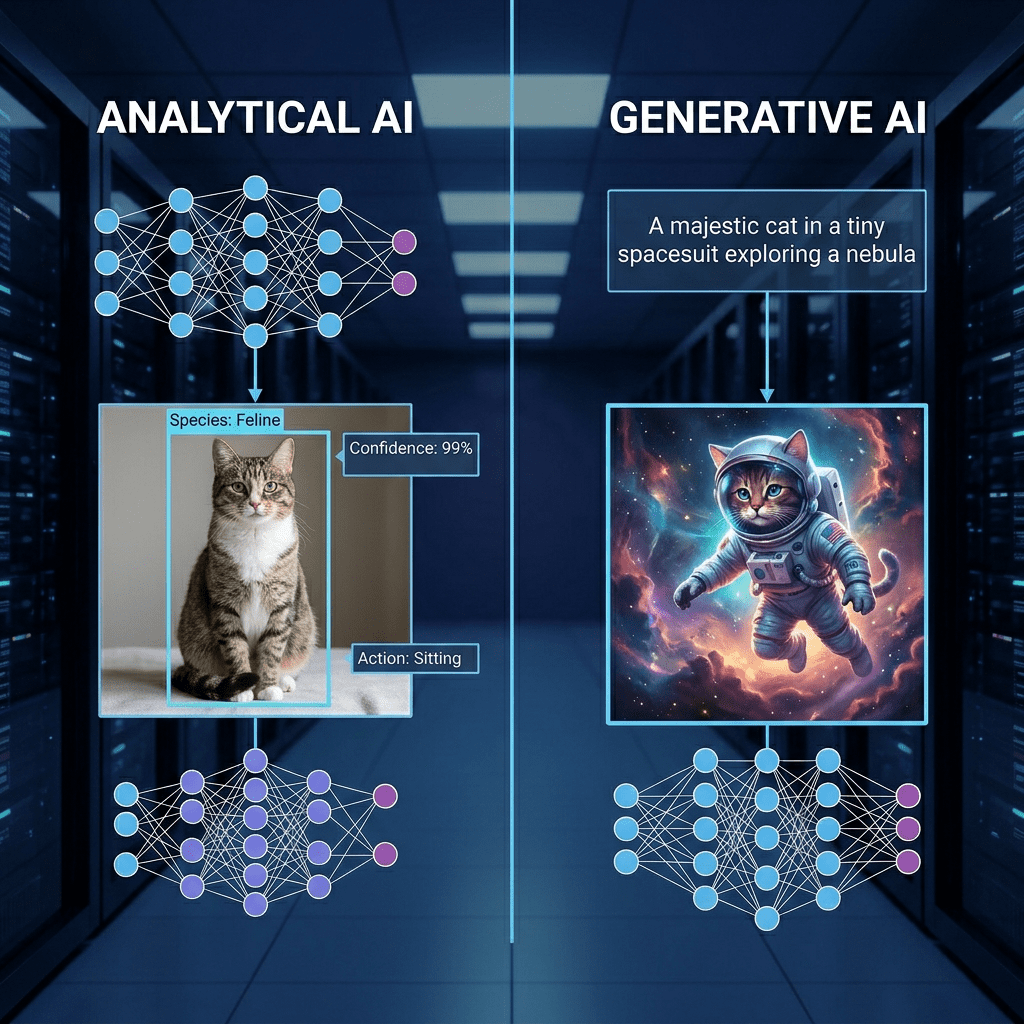
Not all AI creates things. It’s worth understanding the distinction, because it changes what you can expect from a tool.
| Traditional AI | Generative AI |
| Analyzes and classifies existing data | Creates brand-new content |
| Recognizes whether an email is spam | Writes the email for you |
| Identifies a tumor in a scan | Drafts a medical summary report |
| Recommends what to watch next | Writes a script for a show |
| Detects fraud in transactions | Generates a fraud-awareness training module |
Traditional AI asks: “What is this?” Generative AI asks: “What should I make?” Both are useful. But generative AI is the one turning heads in professional settings right now.
How Does Generative AI Actually Work?
You don’t need to be an engineer to understand this. Here’s the plain-English version in three steps.
-
- Training. The AI is fed enormous amounts of data — think billions of web pages, books, conversations, images, and code. It processes all of it and learns statistical patterns. It learns that certain words follow other words, that certain visual patterns represent objects, that certain structures make music sound harmonious.
-
- The Model. All that learning gets compressed into what’s called a model — a mathematical representation of everything the AI has absorbed. Large Language Models (LLMs) like the ones powering ChatGPT and Claude are examples of generative AI models trained specifically on text.
-
- Generation. When you type a prompt, the model uses what it has learned to predict the most useful, coherent, contextually appropriate response — and produces it in real time. It’s not retrieving a pre-written answer. It’s constructing something new, word by word, pixel by pixel, note by note.
I compare this to how a skilled chef works. They don’t follow a single recipe every time. They’ve internalized so many techniques and flavor combinations that they can improvise a brand-new dish from whatever ingredients you hand them. Generative AI operates on the same principle — deep pattern mastery enabling creative output on demand.
What Can Generative AI Actually Do?
The short answer: more than you probably think. Here’s a practical breakdown by output type.
Text and Writing
-
- Draft emails, reports, proposals, and presentations
-
- Summarize long documents or meeting transcripts
-
- Rewrite content at different reading levels or tones
-
- Translate between languages
-
- Write social media posts, ad copy, and blog articles
Images and Visual Content
-
- Generate illustrations and artwork from text descriptions
-
- Create marketing visuals, logos, and mockups
-
- Edit and enhance existing photos
-
- Design product images without a photographer
Audio and Video
-
- Generate voiceovers and narration from text
-
- Clone or synthesize voices for podcasts and training videos
-
- Create background music for videos
-
- Generate short video clips from prompts (emerging capability)
Code and Data
-
- Write, explain, and debug software code
-
- Translate code between programming languages
-
- Analyze datasets and generate plain-English summaries
-
- Build formulas and scripts for Excel, Google Sheets, and more
What Are Real-World Examples of Generative AI in Professional Life?
Here’s where this gets useful. These aren’t hypothetical — these are things professionals are doing right now.
-
- A marketing manager uses ChatGPT to generate 10 variations of ad copy for an A/B test in the time it used to take to write one.
-
- A small business owner uses Claude to read a 40-page vendor contract and summarize the top five risks in plain English.
-
- A consultant uses Otter.ai (powered by generative AI) to transcribe client interviews and auto-generate action items.
-
- A teacher uses generative AI to create differentiated lesson plans for students at three different reading levels — in minutes instead of hours.
-
- A software developer uses GitHub Copilot (a generative AI tool) to write boilerplate code, freeing their brain for the hard architectural problems.
-
- An HR professional uses generative AI to draft job descriptions, interview questions, and onboarding documents tailored to specific roles.
I share examples like these throughout AI for Beginners Demystified, including stories from my own marketing company where generative AI has become part of everyday workflows. The lesson is consistent. Generative AI works best when it amplifies what a human already knows, not when it operates without human judgment.
What Are the Most Popular Generative AI Tools?
Here’s a quick reference to the most widely used generative AI tools by type:
| Tool | What It Generates |
| ChatGPT (OpenAI) | Text, code, analysis, images |
| Claude (Anthropic) | Text, long-document analysis, nuanced reasoning |
| Google Gemini | Text, images, multimodal tasks |
| Microsoft Copilot | Text, code, integrated into Microsoft 365 |
| DALL-E 3 (OpenAI) | Images from text descriptions |
| Midjourney | Highly stylized AI images and artwork |
| GitHub Copilot | Code generation and debugging |
| ElevenLabs | Realistic AI voice synthesis and audio |
| Runway ML | Video generation and editing |
| Jasper AI | Marketing copy, blog content, brand voice |
I’ve been using AI for two years now, and it has completely transformed how I work. Tools like ChatGPT, Gemini, and Claude handle everything from writing to problem-solving, making my workflow faster, smoother, and more creative. Instead of juggling multiple processes, I rely on these AI assistants as my daily toolkit—and honestly, I’m happier and more productive because of it.
As of early 2026, the “Big Three” AI providers have converged on a very similar pricing structure for individual users, though they offer different high-capacity tiers for professionals. I do very well with ChatGPT ($20/Month), Gemini ($19.99/Month), and Claude ($0/Month). I already had a Google Pro Plan, so Gemini was included. Gemini Pro is hard to beat for value if you already use Google Drive and need the extra 2TB of cloud storage. And, I am doing very well with basic Claude.
How Do You Get Started With Generative AI as a Beginner?
Here’s a simple, no-panic starter plan — tested on real beginners.
-
- Start with a free text-based tool. Go to chat.openai.com (ChatGPT) or claude.ai (Claude). Both have free tiers and take about two minutes to sign up. I just use my Google Email creds for both.
-
- Ask it something real. Don’t start with “tell me a joke.” Give it a task to perform. One of the very first tasks I asked ChatGPT to perform for me was this: “I have a 2024 Volvo XC 60.” The key fob got wet. Provide instructions on how to dry it out and get it working again. Along with a detailed list of instructions and
 precautions, it sent me this picture of the key fob disassembled.
- Ask it something real. Don’t start with “tell me a joke.” Give it a task to perform. One of the very first tasks I asked ChatGPT to perform for me was this: “I have a 2024 Volvo XC 60.” The key fob got wet. Provide instructions on how to dry it out and get it working again. Along with a detailed list of instructions and
Not bad, but I wanted to see if I could do better. So, I asked Gemini’s Nano Banana to do this: “Create a black and white image on how to disassemble a key fob for a 2024 Volvo XC 60.”
-
- Learn to prompt better. The quality of what generative AI produces depends almost entirely on how clearly you ask. Specific, detailed prompts = dramatically better outputs.
The above examples provide a great example of learning to prompt better. My first prompt was answered. I got the instructions I asked for. But my second prompt got me exactly what I wanted.
-
- Always review the output. Generative AI can produce errors, outdated information, or confident-sounding nonsense (called hallucinations). Treat it like a very smart first draft, not a final authority.
-
- Expand to a second tool. Once you’re comfortable with text generation, try an image tool like DALL-E (ChatGPT’s image generator) or Nano Banana (Google’s Gemini image platform).
-
- Keep learning. The field moves fast. Following resources like ricksamara.com and reading AI for Beginners Demystified will keep you ahead of the curve without the technical overwhelm.
What Is a Prompt and Why Does It Matter for Generative AI?
A prompt is your instruction to the generative AI — the text you type to tell it what to create. Think of it as a conversation starter with a very capable collaborator who needs clear direction.
The quality of a generative AI output is almost entirely determined by the quality of the prompt. This is why “prompt engineering” has become a genuine professional skill.
|
Prompt Quality in Action Weak prompt: “Write something about our company.” Strong prompt: “Write a 200-word company overview for a landscaping business serving residential clients in suburban Maryland. Tone: friendly and professional. Emphasize 20 years of experience and eco-friendly practices.” The second prompt gives the AI context, scope, audience, tone, and key details. The output will be dramatically more useful. |
What Are the Limitations and Risks of Generative AI?
Being a smart user of generative AI means understanding where it falls short. Here’s an honest rundown:
-
- Hallucinations. Generative AI can produce confident-sounding information that is completely wrong. Always verify facts, especially for anything consequential.
-
- Bias. AI is trained on human-generated data, which contains human biases. Outputs can reflect those biases in subtle and not-so-subtle ways.
-
- No real-time knowledge (usually). Many generative AI tools have a knowledge cutoff date. They don’t know what happened last week unless they have web search capabilities enabled.
-
- Copyright and attribution. Content generated by AI may resemble existing copyrighted work. Use AI-generated content thoughtfully, especially for commercial purposes.
-
- Privacy. Be cautious about entering sensitive personal, client, or proprietary business information into consumer-facing generative AI tools.
-
- Over-reliance. The biggest professional risk isn’t AI replacing you — it’s becoming dependent on AI in ways that dull your own critical thinking. Use it as a collaborator, not a crutch.
I address each of these points in AI for Beginners Demystified, with practical guidance on how to use generative AI responsibly and effectively — without either fearing it or blindly trusting it.
Is Generative AI Going to Replace My Job?
Let’s tackle the elephant in the room.
Generative AI will reshape many jobs. It will automate certain tasks within virtually every profession. But outright replacement of human judgment, creativity, relationships, and accountability? That’s a different, and much longer story.
If Artificial Intelligence is brand new to you, I recommend you check out my Best Books on AI: The Ultimate Guide to Learning Artificial Intelligence in 2026
The analogy I like to use is worth repeating: when calculators were introduced, they didn’t replace accountants. They made accountants dramatically more productive. Generative AI is the calculator of the knowledge economy.
What is true? The professional who learns to harness generative AI will outperform and probably out-earn the one who refuses to engage with it. The skill isn’t “use AI instead of thinking.” The skill is “use AI to do more of your best thinking.”
What Are the Top Four Books on Generative AI?
Want to go deeper? These four books are excellent next steps for someone moving from curious beginner to informed practitioner.
| Book #1 — AI for Beginners Demystified By Rick Samara The starting point for anyone who wants to understand AI — including generative AI — without drowning in technical jargon. Rick uses humor, storytelling, and real-world examples drawn from his background as a U.S. Air Force Intelligence Analyst and marketing entrepreneur to make every concept feel approachable. Covers machine learning, neural networks, generative AI, large language models, and practical applications. The ideal first book before tackling the heavier reads on this list. Get AI for Beginners Demystified at ricksamara.com/book |
| Book #2 — The Age of Generative AI By Michael R. Bhaskar A compelling and well-researched look at how generative AI is reshaping creativity, work, and society. Bhaskar explores both the immense promise and the sobering implications of a world in which AI can generate on demand. Accessible to non-technical readers while still substantive enough to satisfy the analytically curious. Strong on the big-picture implications of generative AI for industries, culture, and the future of human creativity. |
| Book #3 — Co-Intelligence: Living and Working with AI By Ethan Mollick Wharton professor Ethan Mollick brings practical wisdom and research-backed insights to one of the most important questions of our era: how do we work effectively alongside generative AI? This is not a doom-and-gloom tech book. It’s a thoughtful, optimistic, and actionable guide to treating AI as a collaborator — and getting dramatically better results as a result. Highly recommended for professionals at any level who want to use generative AI intelligently. |
| Book #4 — Impromptu: Amplifying Our Humanity Through AI By Reid Hoffman with GPT-4 LinkedIn co-founder Reid Hoffman wrote this book in direct collaboration with GPT-4, making the book itself a demonstration of generative AI in action. It covers how generative AI will affect education, creativity, justice, and work — with Hoffman and the AI trading perspectives throughout. It’s thought-provoking, optimistic, and a genuinely unique reading experience. A great choice for professionals who want to understand the philosophical and societal dimensions of generative AI alongside the practical ones. |
| Accessibility Note This article is written in plain, accessible English in accordance with ADA readability guidelines. Key terms are defined on first use. All headings are structured to support screen reader navigation. Contrast ratios in this document meet WCAG 2.1 AA standards for readability. If you require this content in an alternative format, please contact Rick Samara through ricksamara.com/contact-us. |
Frequently Asked Questions About Generative AI
 What is the simplest definition of generative AI?
Generative AI is artificial intelligence that creates new content — text, images, audio, video, or code — by learning patterns from large amounts of existing data. It’s the technology behind tools like ChatGPT, Claude, and DALL-E.
Is generative AI the same as ChatGPT?
No. ChatGPT is a tool powered by generative AI, but generative AI is the broader category of technology. Just as “search engine” is broader than “Google,” generative AI is broader than ChatGPT. Other generative AI tools include Claude, Gemini, Midjourney, GitHub Copilot, and dozens more.
Do I need technical skills to use generative AI?
No. Most generative AI tools are designed for everyday users. If you can type a sentence, you can use generative AI. The one skill worth developing is writing better prompts — and that comes naturally with a little practice.
Is generative AI safe to use for work?
For most professional tasks, drafting communications, brainstorming, summarizing, yes, generative AI tools are safe and effective. Use caution when entering confidential client data, proprietary business information, or personal health data into consumer-grade AI tools unless your organization has a data privacy agreement with the provider.
What is a hallucination in generative AI?
A hallucination is when generative AI produces information that sounds confident and plausible but is factually incorrect. It’s one of the most important limitations to understand. Always verify critical facts, statistics, dates, or citations that an AI tool produces before using them professionally.
How is generative AI different from a search engine?
A search engine retrieves existing content from the web. Generative AI creates new content based on patterns it has learned. When you Google something, you get links to existing pages. When you prompt a generative AI tool, it constructs a new response tailored specifically to your question — it isn’t pulling a pre-existing answer.
What does ‘large language model’ mean?
A large language model (LLM) is a type of generative AI trained specifically on text. The ‘large’ refers to both the amount of data it was trained on and the number of parameters (mathematical variables) in its design. ChatGPT, Claude, and Gemini are all large language models. They’re called ‘language’ models because they were designed to understand and generate human language.
How do I avoid becoming too dependent on generative AI?
Use generative AI as a collaborator, not a replacement for your own thinking. Always review and edit AI-generated content. Keep sharpening your own judgment and expertise — generative AI amplifies human capability; it shouldn’t replace the development of it. As I put it, the goal is to be the chef, not just in the kitchen.
Related Articles on RickSamara.com
Continue building your AI knowledge with these articles:
-
- AI for Beginners: A Simple Guide to Understanding Artificial Intelligence — New to AI entirely? Start here for a solid foundation.
-
- Build AI Confidence: From Beginner to Practitioner — Your step-by-step roadmap for moving from AI-curious to AI-capable.
-
- Best Books on AI: The Ultimate Guide to Learning Artificial Intelligence in 2026 — A curated reading list for every stage of your AI journey.
-
- AI Intimidation: Why People Fear AI and Why They Shouldn’t — A reassuring look at the gap between AI fear and AI reality.
-
- Top 10 Things You Should Know About Machine Learning in Artificial Intelligence — Generative AI runs on machine learning. This article explains how.
-
- AI for Small Business Owners: Practical Ways to Use Artificial Intelligence — Practical applications of generative AI for entrepreneurs and small teams.
-
- OpenAI’s Role in Everyday AI Usage — Who built ChatGPT and how OpenAI is shaping the generative AI landscape.
-
- Future-Proof: What Makes a Career Resilient in the Age of AI? — How generative AI is reshaping careers and what you can do about it.
-
- A History of Artificial Intelligence (AI) — Understand how we got to generative AI by tracing the full arc of AI history.
-
- Your AI Workflow for Writing Blog and Article Posts: A Beginner’s Upgrade Kit — Put generative AI to work immediately with this practical writing workflow.
Further Reading and Sources
The following external resources were used to inform and support this article. All outbound links are do-follow:
-
- Google — What Is Generative AI? A Guide for Everyone — Google’s own accessible explainer on generative AI fundamentals.
-
- McKinsey & Company — What Is Generative AI? — A comprehensive business-focused overview from McKinsey Global Institute.
-
- IBM — What Is Generative AI? — IBM’s technical yet accessible explanation of generative AI models and applications.
-
- MIT Technology Review — Generative AI Coverage — Ongoing reporting on generative AI research, breakthroughs, and societal impact.
-
- OpenAI — Research Overview — Primary source for understanding how GPT models and DALL-E were developed.
-
- Anthropic — AI Safety and Claude — The research company behind Claude, with resources on responsible generative AI.
-
- Ethan Mollick — One Useful Thing (Substack) — Wharton professor Ethan Mollick’s essential newsletter on practical generative AI use.
-
- Stanford HAI — Generative AI Research — Stanford’s Human-Centered AI Institute research and perspective on generative AI.
| Want the Full Picture? AI for Beginners Demystified by Rick Samara covers generative AI, machine learning, neural networks, and practical applications — all in plain English, with humor and real-world examples. No tech background required. Get the book at ricksamara.com/book |
© 2026 Rick Samara | ricksamara.com | All rights reserved.