 A website article prompt is the instruction you give AI to generate a structured, focused, and SEO-ready article. Think of it as the blueprint. If the blueprint is vague, the house looks… interesting. If the blueprint is clear, the results are impressive.
If you’re just starting to experiment with AI, you may think the magic happens in the software.
It doesn’t.
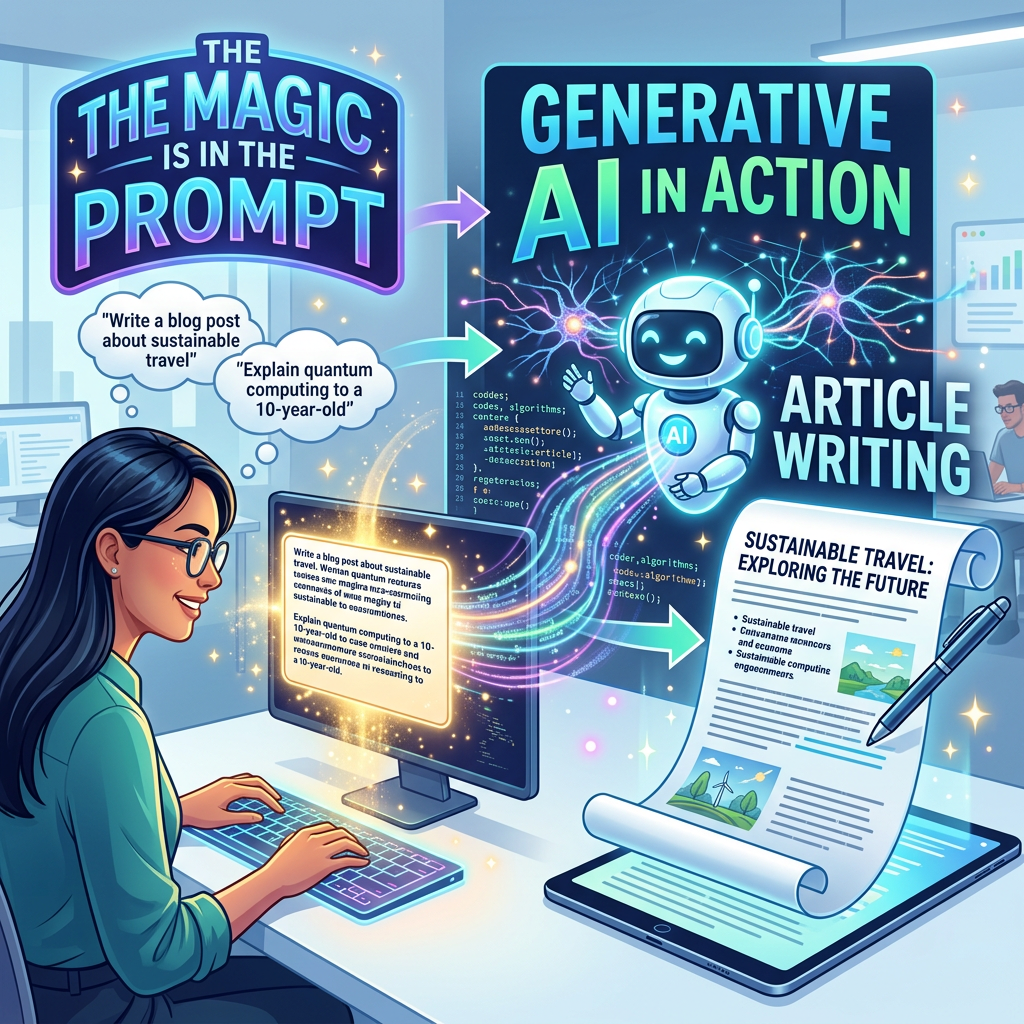
The magic happens in the website article prompt. This is a great example of Generative AI in action.
A website article prompt is the instruction you give AI to generate a structured, focused, and SEO-ready article. Think of it as the blueprint. If the blueprint is vague, the house looks… interesting. If the blueprint is clear, the results are impressive.
In other words, better input equals better output. Revolutionary concept, I know. Just kidding! What you about to learn forms the basis of the same exact prompt I use for my content creation. This really works!
What Is a Website Article Prompt?
A website article prompt is a structured instruction that tells AI:
- What topic to write about
- Who the audience is
- The tone and style to use
- Word count expectations
- Formatting requirements
- SEO elements to include
It transforms AI from a guessing machine into a strategic assistant.
Without a clear prompt, AI fills in the blanks on its own. With a clear prompt, it aligns with your goals.
And alignment saves time.
Why the Three-Word Prompt Matters
Here’s where beginners often miss a critical step.
Your focus keyword should ideally be three words.
Not one. Not a vague paragraph. Three specific words.
For example:
- “Website article prompt”
- “Local SEO strategy”
- “AI content workflow”
Why three words?
1. It Creates Clarity
Three-word prompts are specific enough to guide direction but broad enough to allow explanation.
One word is too vague.
Five words often dilute focus.
Three words hit the sweet spot.
2. It Improves SEO Precision
Search engines evaluate relevance based on keyword intent (Fishkin, 2020). A focused three-word phrase signals clear intent and reduces ambiguity.
For example, “prompt” alone is unclear.
“Website article prompt” tells both readers and search engines exactly what the content addresses.
Clarity helps ranking. Ranking helps visibility.
3. It Reduces AI Drift
When you give AI a long, fuzzy topic, it may wander. A three-word focus keyword anchors the content.
It’s like giving directions with a street name instead of “somewhere near downtown.”
How to Build an Effective Website Article Prompt
 If you’re new to this, keep it simple.
Your prompt should include:
1. The Focus Keyword
State it clearly.
Example:
“Write an article based on the focus keyword: website article prompt.”
2. Tone and Audience
Tell AI who the article is for.
Example:
“Use a friendly voice. Explain it for beginners experimenting with AI.”
3. Structural Requirements
Specify:
- Word count
- SEO elements (meta title and description)
- Citation style (APA)
- A Further Reading section
The more structured the instruction, the more structured the result.
Why Beginners Should Care
If you’re just experimenting with AI, you might be tempted to type something like:
“Write something about prompts.”
That will produce something.
But it won’t produce something strategic.
A structured website article prompt:
- Saves editing time
- Improves clarity
- Enhances SEO performance
- Produces consistent formatting
- Builds credibility
Research on effective communication emphasizes structured guidance for improved outcomes (Mayer, 2021). AI works the same way. Clear structure produces clearer output.
A Simple Framework You Can Use Today
 Try this:
Write an article based on this focus keyword: WEBSITE ARTICLE PROMPT.
Use a friendly tone with light humor.
Keep it under 800 words.
Explain it for beginners learning AI.
Follow APA style.
Include a Further Reading section with dofollow links.
Create a Meta title and description.
That’s it.
You don’t need complicated engineering. You need intentional instruction.
Final Thought
AI is powerful. But it is still a tool.
The website article prompt is what turns that tool into a system.
And the three-word focus keyword? That’s the steering wheel.
When you control the steering wheel, the content goes where you want it to go.
Without it, you’re just along for the ride.
Efficiency is good.
Direction is better.
Further Reading
Fishkin, R. (2020). Lost and founder: A painfully honest field guide to the startup world. Portfolio. https://www.penguinrandomhouse.com/books/586854/lost-and-founder-by-rand-fishkin/
Mayer, R. E. (2021). Multimedia learning (3rd ed.). Cambridge University Press. https://www.cambridge.org/core/books/multimedia-learning/
Patel, N. (2023). The beginner’s guide to SEO. https://neilpatel.com/what-is-seo/
OpenAI. (2024). Best practices for prompt engineering with AI models. https://openai.com/research