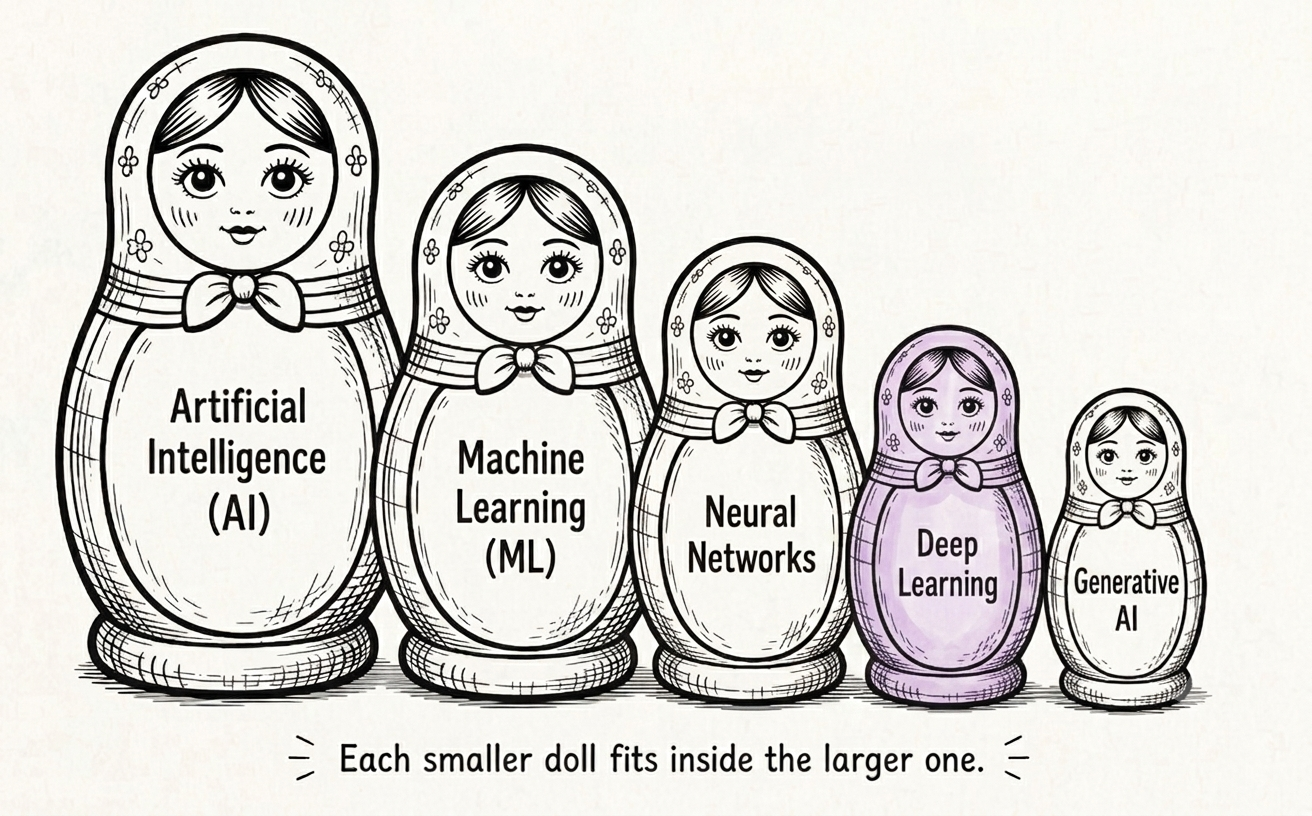
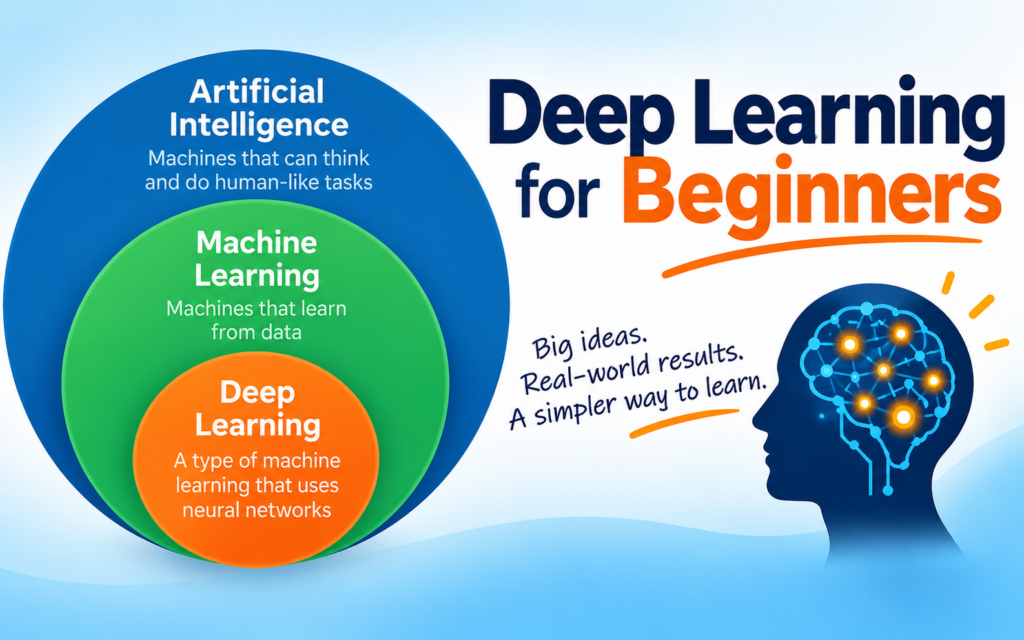
This article will simplify deep learning for beginners. Imagine teaching a child to recognize a cat. You do not hand them a checklist of fur length, ear shape, and tail thickness. Instead, you show them many pictures of cats until their brain starts spotting the pattern on its own. Deep learning works in a similar way. It learns directly from examples, discovering patterns without being explicitly programmed for every rule. That ability makes it the engine behind some of the most impressive artificial intelligence today. If you have ever wondered how self-driving cars see the road or how voice assistants understand your words, you are already curious about deep learning. This article gives you a friendly, jargon-light look at what deep learning is, how it works, and why it matters for beginners.
I would highly recommend going back to the first article of this series to help establish a stronger framework for where all this fits in: AI Basics for Beginners: Your First Step to Understanding Artificial Intelligence
Deep Learning for Beginners: What Is Deep Learning?
Deep learning is a branch of artificial intelligence that uses multi-layered neural networks to learn patterns from large amounts of data. It is a subset of machine learning, but with a key difference. The neural networks used in deep learning have at least four layers, often hundreds. These layers are inspired by the structure of the human brain, where each layer processes information and passes it to the next. Because of this depth, deep learning models can automatically learn features directly from raw data. That data can be images, text, or sound. Traditional machine learning, by contrast, often requires human experts to manually engineer the features the model uses.
Deep Learning for Beginners: How Does Deep Learning Work? (In Simple Terms)
Think of a deep neural network as a factory assembly line. Raw material, like a digital image, enters at one end. Each station, or layer, checks the material. It decides what information to keep and what to pass along. The stations are connected by weighted pathways. These weights act like importance knobs. As the network learns, it adjusts these knobs. Some connections become stronger, others weaker. An activation function acts as a decision-maker at each station. It determines whether the signal is strong enough to proceed. This whole process is called forward propagation.
After the network makes a guess, it checks how wrong it was using a loss function. Then it works backward through the layers, called backpropagation, to tweak the weights and biases so that the next guess is a little better. This loop repeats many times. The learning rate controls how big each adjustment is. If this sounds like just a lot of back-and-forth, cleaning, and filtering, then that is what it is!
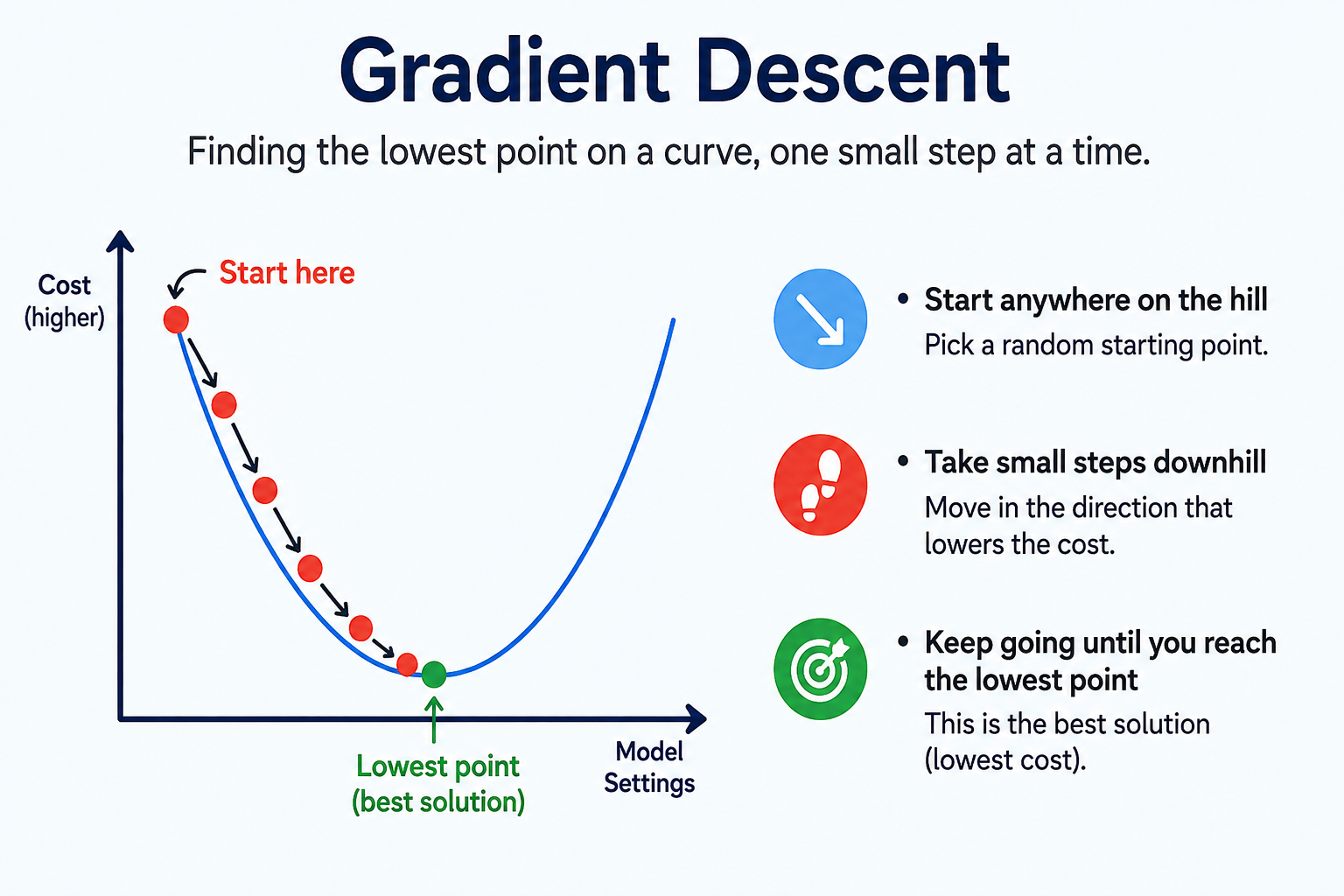
Optimizers like Gradient Descent, Stochastic Gradient Descent, or the popular Adam optimizer guide these adjustments efficiently. Over many rounds of forward and backward passes, the network improves at recognizing patterns in the data.
Deep Learning vs. Traditional Machine Learning
Understanding the difference between deep learning and traditional machine learning helps clarify deep learning for beginners. It also helps explain why deep learning has become so popular for complex tasks. The table below highlights the main contrasts based on the characteristics found in standard learning resources.
Feature | Deep Learning | Traditional Machine Learning |
|---|---|---|
Feature engineering | Learns features automatically from data | Often requires manual feature engineering by experts |
Network depth | Uses multi-layered neural networks (at least 4 layers) | Usually uses shallow networks or other algorithms (e.g., decision trees, SVMs) |
Data type handled | Excels with unstructured data (images, audio, text) | Works well with structured, tabular data |
Dataset size | Performs best with very large datasets | Can work with smaller datasets |
Accuracy potential | Often achieves very high accuracy on complex tasks | Good accuracy, but may plateau without manual tuning |
It is also helpful to distinguish deep learning from neural networks in general. A neural network can have just one or two hidden layers. Deep learning specifically describes training neural networks with multiple hidden layers, at least four layers. So all deep learning uses neural networks, but not every neural network counts as deep learning.
Deep Learning for Beginners: Where Is Deep Learning Used Today?
Deep learning models power many of the state-of-the-art AI applications you hear about. In computer vision, they enable systems to identify objects, faces, and even the content of an image. Generative AI tools, such as those that create realistic images or write human-like text, rely on deep learning under the hood. It is amazing to watch how images are created in chatbots. I use ChatGPT most of the time to create my images.
This is what happens:
-
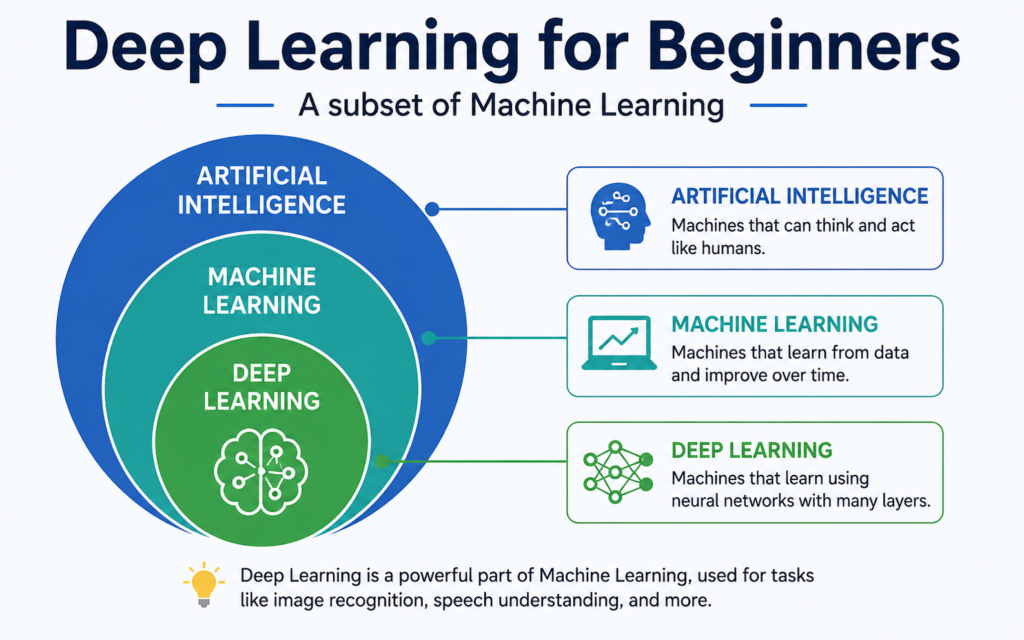
I give it a prompt. I used this simple prompt: [Create a featured image titled “Deep Learning for Beginners.” It should be 800 x 500. Show it as a subset of Machine Learning. Keep it simple.]
-
ChatGPT goes into action. It tells me it’s creating an image. Then it tells me it is sketching it out. It keeps going. It then makes a first draft. Then it actually produces two images and asks which one I like best. Here is my second choice:
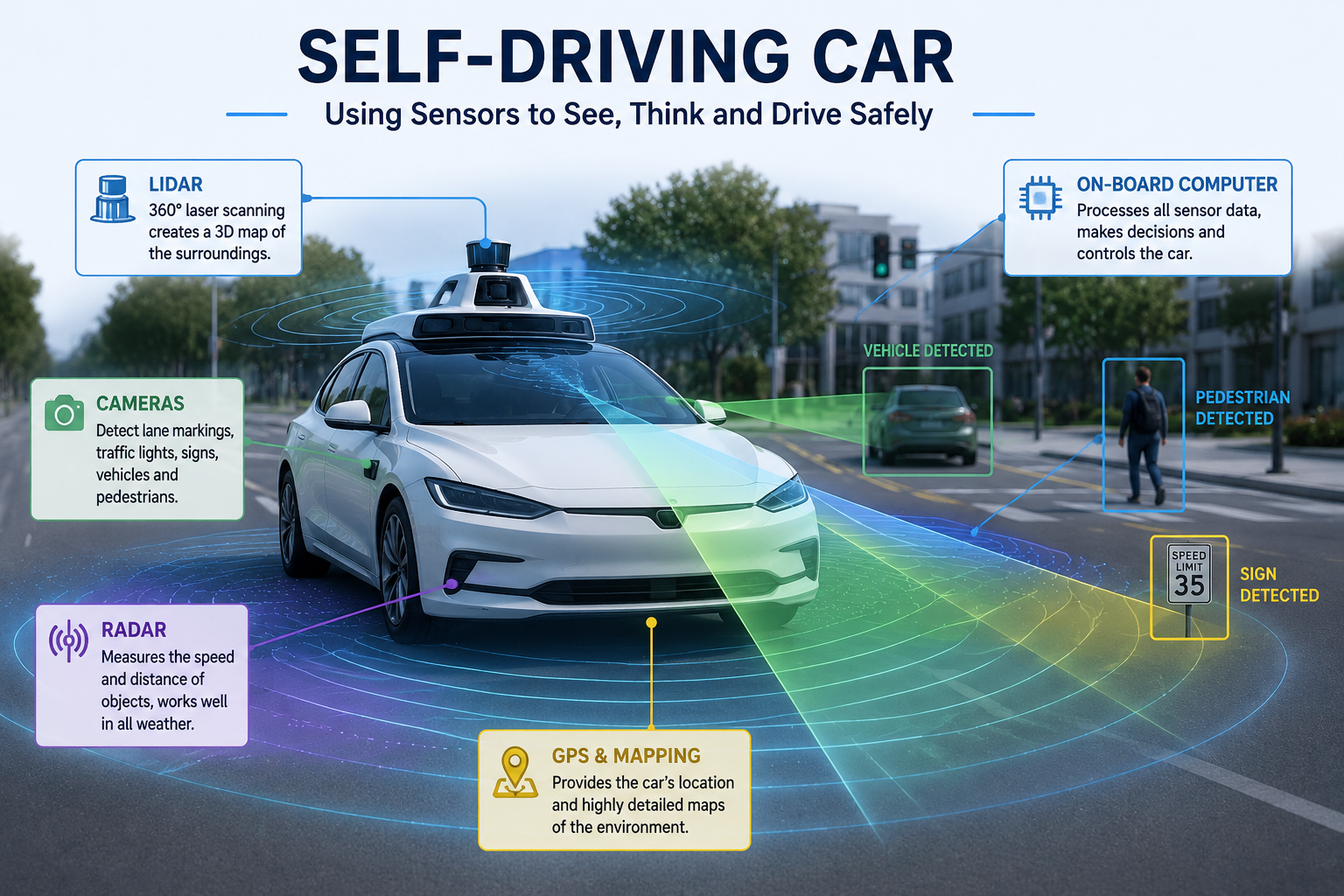
Self-driving cars use deep learning to interpret sensor data and make driving decisions. Robotics systems use it to manipulate objects and navigate environments. In everyday technology, deep learning is employed in image recognition on your phone. Deep learning is used in speech processing in virtual assistants and natural language understanding in translation apps. These applications all benefit from deep networks’ ability to automatically detect patterns and handle large, unstructured datasets.
Building Blocks of a Deep Neural Network
To get comfortable with deep learning, it helps to know the main components of a neural network. Here are the key pieces explained in plain language:
-
Layers – The input layer receives the raw data. Hidden layers (at least four in a deep network) process the data step by step. The output layer produces the final prediction.
-
Weights and biases – These are adjustable numbers that the network learns. Weights control the strength of connections between neurons; biases allow the network to shift the output.
-
Activation functions – They act as decision-makers at each neuron, deciding whether the neuron should be activated (fire) based on the weighted sum of inputs.
-
Forward propagation – The process of passing input data through the layers to produce an output.
-
Loss function – A measure of how far the network’s prediction is from the true answer.
-
Backpropagation – The algorithm that calculates how much each weight and bias contributed to the error, so they can be adjusted.
-
Learning rate – A small number that determines how big a step the network takes when updating weights during training.
Optimization algorithms such as Gradient Descent are used to efficiently guide weight updates.
Common Architectures: Convolutional Neural Networks
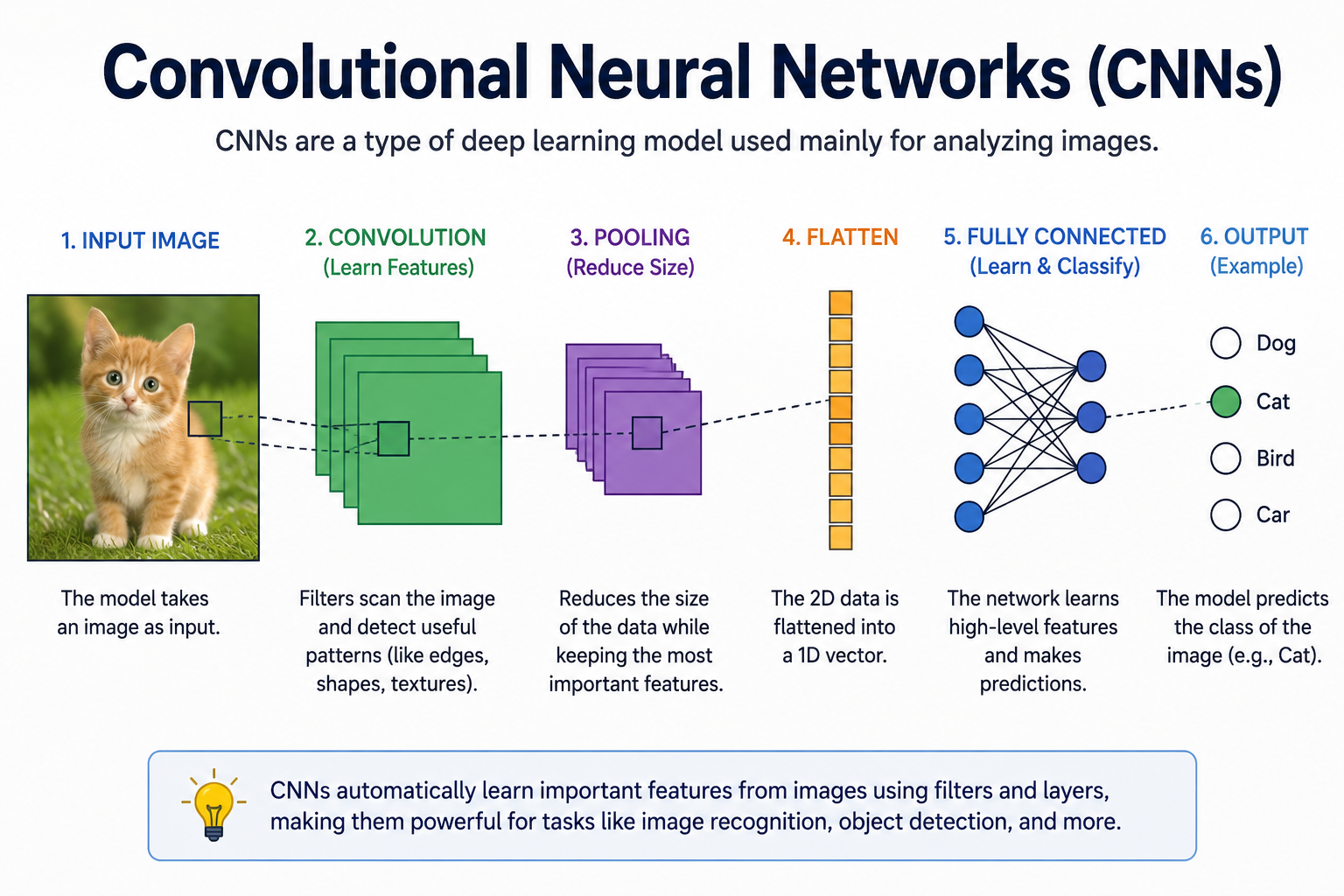
One of the most widely used types of deep networks is the Convolutional Neural Network, or CNN. CNNs are designed specifically for processing grid-like data such as images. They use special layers that scan small portions of the image, learning to detect edges, textures, and eventually whole objects.
Over the years, researchers have developed several classic CNN architectures that advanced the field. Each architecture introduced innovations that made networks deeper, faster, or more efficient.
Getting Started with Deep Learning for Beginners
You do not need a PhD in mathematics to begin learning deep learning. Start by building a strong intuition for how neural networks learn from data. Focus on understanding the flow from input to output, the role of weights and activation functions, and the training loop of forward propagation and backpropagation. Experiment with small datasets using beginner-friendly tools. Many online courses and tutorials walk you through the first steps without overwhelming you with calculus. The key is to connect each concept to a mental image, like the assembly line or the student learning from mistakes, so the ideas stick.
If you are looking for a resource that explains these topics in plain English, AI for Beginners Demystified by Rick Samara provides exactly that kind of approach. The book is written for non-technical readers who want to move from curiosity to confidence in AI. By combining simple analogies with real-world context, it helps you understand deep learning as a natural extension of how humans learn, not as an impenetrable set of formulas.
Frequently Asked Questions
What is the difference between artificial intelligence, machine learning, and deep learning?
Artificial intelligence is the broad field of creating machines that can perform tasks that usually require human intelligence. Machine learning is a subset of AI where systems learn from data without being explicitly programmed. Deep learning is a further subset of machine learning that uses multi-layered neural networks to learn from large amounts of data.
Do I need a powerful computer to learn deep learning?
For the very first steps, a standard laptop or desktop computer is enough. Many online platforms let you run small deep learning experiments in a web browser or through cloud services. As you progress to larger models, a computer with a graphics processing unit (GPU) speeds up training, but you can start learning the concepts without expensive hardware.
How much data does a deep learning model need?
Deep learning models generally require large datasets to perform well. The exact amount depends on the task complexity and network depth. There is no fixed minimum, but many practical examples use thousands or millions of examples. For beginners, it is fine to start with small public datasets to practice the training process.
What is the role of an activation function?
An activation function determines whether a neuron should be activated based on the weighted sum it receives. It introduces non-linearity into the network, which allows the model to learn complex patterns. Common activation functions include ReLU, sigmoid, and tanh. Without them, a deep network would just behave like a simple linear model.
Deep learning might sound intimidating at first, but at its core it is a way of teaching computers to learn from examples, the same way any of us learns a new skill. By breaking down the parts and understanding the process, you can build a solid foundation that opens the door to modern AI. Whether you want to understand how your photo app tags faces, how a chatbot answers your questions, or how a car drives itself, deep learning is the engine behind it. Start with the basics, stay curious, and let the patterns reveal themselves naturally.
I hope you enjoyed this article on deep learning for beginners. I encourage you to continue your quest to learn more about this amazing technology.

Former USAF Intelligence Officer | Award-Winning Author | AI Marketing Strategist
Rick Samara is a former Air Force Intelligence Officer and award-winning author of AI for Beginners Demystified. Drawing on his background in translating complex intelligence data into simple, actionable insights, Rick specializes in helping small business owners, professionals, and everyday learners embrace artificial intelligence without getting lost in technical jargon. He is the founder of E-Internet Marketing Services LLC and publishes AI literacy content at ricksamara.com. Rick works with clients nationally via video conferencing.