Introduction
Modern Artificial Intelligence books are adapting to how people want to learn about this technology. Artificial Intelligence is no longer a niche topic reserved for data scientists or Silicon Valley engineers. In the United States, AI has become part of everyday life, powering everything from smartphone recommendations and fraud detection to healthcare diagnostics and smart home systems.
Yet despite this shift, most people still feel overwhelmed when they try to understand it. This creates a Great paradox in the use of AI.
That’s exactly why New Books On AI, especially Artificial Intelligence Books For Beginners, are experiencing a major transformation. These books are no longer dense technical manuals filled with equations and code. Instead, they are becoming practical learning tools designed for everyday readers, entrepreneurs, students, professionals, and curious learners who want clarity, not complexity.
For readers looking for a complete starting point, The Ultimate Guide to Learning Artificial Intelligence in 2026 provides a broader roadmap for understanding essential AI concepts, choosing suitable learning resources, and building practical knowledge step by step.
This shift is redefining how Americans build technological literacy in the age of AI.
Modern Artificial Intelligence Books: Why Are AI Books Evolving Fast?
Over the past decade, AI has moved from research labs into mainstream business and consumer applications. In the United States alone, companies in healthcare, finance, retail, and logistics now rely heavily on AI-driven systems to operate efficiently.
As a result, the audience for AI education has changed dramatically.
Modern readers are not necessarily engineers. They are:
- Business owners trying to integrate AI tools into operations
- Professionals adapting to workplace automation
- Students preparing for AI-driven careers
- Entrepreneurs exploring AI-powered products
This new audience does not need academic theory first they need understanding, context, and real-world relevance.
That’s why AI Books For Beginners are evolving rapidly: they are designed to explain what AI does, not just how it works mathematically.
Modern Artificial Intelligence Books: Why the Shift from Technical to Beginner-Friendly Learning?
Traditional AI textbooks focused heavily on programming, algorithms, and mathematical models. While these remain important, they often created a barrier for non-technical readers.
Modern AI books take a different approach:
They prioritize clarity over complexity.
Instead of starting with equations, they start with questions like:
- How does Netflix know what you want to watch?
- Why does your phone recognize your face?
- How does Amazon predict what you will buy next?
This shift reflects a broader educational trend in the U.S.: learning through contextual understanding rather than technical overload.
As a result, New Books On AI now feel less like textbooks and more like guided conversations.
Modern Artificial Intelligence Books: What Makes New Books On AI Different from Traditional Tech Books?
The latest generation of AI books is fundamentally different in structure, tone, and purpose.
Less Coding
Instead of requiring programming knowledge, modern AI books focus on conceptual understanding.
Readers learn:
- What AI does
- Where AI is used
- Why AI matters in daily life
This makes the content accessible to non-technical audiences while still maintaining depth.
More Real-Life Examples
One of the strongest features of modern Artificial Intelligence Books For Beginners is the use of real-world applications.
Instead of abstract explanations, readers see AI in action through:
- Smartphone predictive text
- Fraud detection in banking systems
- Recommendation engines like YouTube and Netflix
- Smart home devices like Alexa and Google Assistant
These examples make AI feel tangible, not theoretical.
Story-Based Learning Approach
Many new AI books now use storytelling as a core teaching method.
This approach is effective because it mirrors how humans naturally learn through experience and narrative.
Rather than reading dry definitions, readers follow:
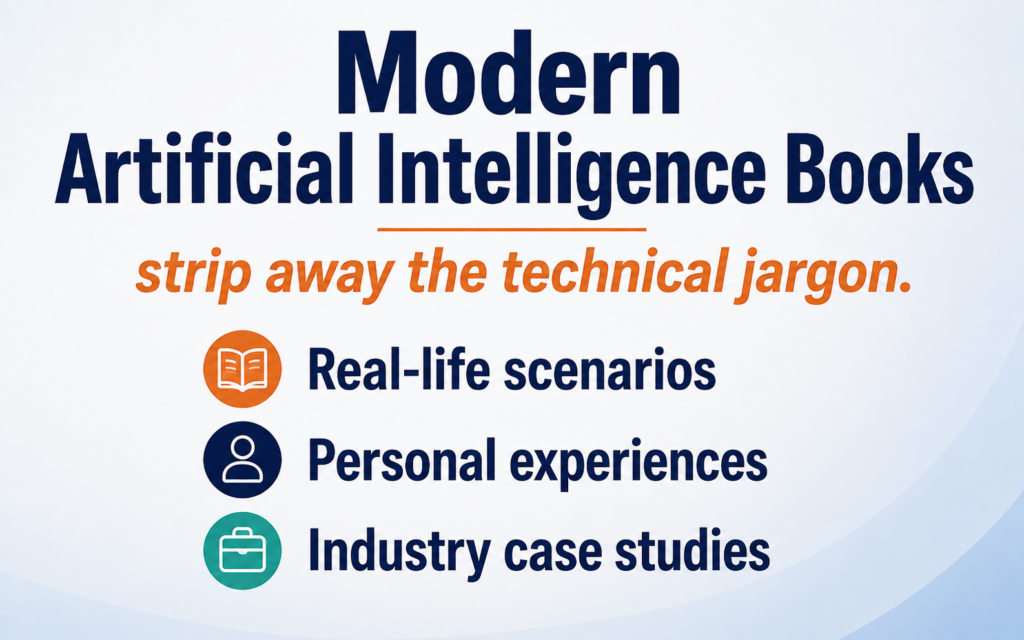
- Real-life scenarios
- Personal experiences
- Industry case studies
This method significantly improves retention and engagement, especially for beginners.
Modern Artificial Intelligence Books: How Are Artificial Intelligence Books For Beginners Structured Today?
Modern AI learning materials are carefully designed to reduce cognitive overload.
Simple Definitions
Key concepts like machine learning, neural networks, and generative AI are explained in plain English.
The goal is not memorization it is understanding.
For example:
- Machine Learning = systems that learn from data
- Neural Networks = systems inspired by the human brain
Generative AI = systems that create content
Everyday Examples
Instead of technical demonstrations, readers see AI applied in familiar environments:
- Shopping apps recommending products
- GPS apps predicting traffic routes
- Email systems filtering spam
- Streaming platforms suggesting content
This bridges the gap between theory and daily experience.
Step-by-Step Learning Flow
Unlike traditional books that jump into complexity quickly, modern AI books follow a structured learning path:
- What AI is
- How AI works in real life
- Key AI technologies
- Industry applications
- Future implications
This structured flow ensures beginners are never lost.
Modern Artificial Intelligence Books: Why Do Beginners Prefer AI Books Over Online Tutorials?
While online tutorials and YouTube videos are popular, Artificial Intelligence Books For Beginners offer unique advantages.
Structured Learning Path
Books provide a complete, organized framework. Unlike scattered online content, they guide readers from foundational knowledge to advanced understanding in a logical sequence.
No Overwhelm
Online platforms often bombard users with fragmented information.
Books eliminate that noise.
They present AI in a controlled, digestible format that reduces confusion and cognitive overload.
Better Retention
Reading a structured narrative improves long-term memory retention compared to short-form videos or random articles.
This is especially important for learners trying to understand complex topics like AI.
Modern Artificial Intelligence Books: The Rise of AI Basics Books in Modern Education
Across the United States, educational institutions and businesses are increasingly integrating AI literacy into their programs.
Schools and Professionals Adopting AI Learning
High schools, universities, and corporate training programs are introducing AI-focused curricula that rely heavily on simplified learning resources.
This includes:
- Introductory AI textbooks
- Workplace AI training manuals
Self-paced AI learning guides
Demand for Simplified AI Knowledge
The demand for AI Basics Books is growing because professionals in non-technical fields marketing, healthcare, finance, and education need AI awareness without becoming engineers.
They need answers to practical questions:
- How can AI improve my workflow?
- What tools should I use?
- What risks should I understand?
Modern Artificial Intelligence Books: How Do New AI Books Help You Understand Real Technology?
One of the most valuable aspects of modern AI books is their focus on real-world systems that people already use daily in the United States.
Smartphones
AI powers features like:
- Face recognition
- Predictive text
- Voice assistants
Smart Homes
Devices like thermostats, smart lights, and home assistants use AI to learn user preferences and automate routines.
Finance Systems
Banks use AI for:
- Fraud detection
- Credit scoring
- Transaction monitoring
Healthcare AI
Hospitals and medical systems use AI to:
- Detect diseases early
- Analyze medical images
- Support personalized treatment
These examples make it clear that AI is not a future concept it is already embedded in daily American life.
Conclusion
AI education is undergoing a major transformation. New Books On AI, especially Artificial Intelligence Books For Beginners and AI Basics Books, are redefining how people learn technology in the United States. They are no longer focused on complexity they are focused on clarity, relevance, and real-world understanding.
The modern learner does not need to become a programmer to understand AI. They need to understand how AI fits into their world. And that is exactly what these new-generation AI books deliver.
AI is no longer the future. It is the present, and learning it has never been more accessible.
Author Bio

Rick Samara is the owner of E-Internet Marketing Services LLC, a digital marketing company founded in 2007 that helps small and local businesses improve their visibility online. With more than 20 years of experience in digital marketing, Rick has worked through major shifts in search technology, from traditional website optimization and local SEO to Google Business Profile management and today’s rapidly developing AI-search environment.
His current work focuses on helping small businesses understand and practically apply artificial intelligence, Answer Engine Optimization, Generative Engine Optimization, LLM citation optimization, and AI-powered business tools without getting buried in technical jargon.
Rick is also an award-winning Amazon author and writes about artificial intelligence and its practical applications for everyday users and businesses.
Further Reading
For readers who want to explore artificial intelligence, AI literacy, responsible AI use, and the growing role of AI education in greater depth, the following authoritative resources provide useful additional information.
National Institute of Standards and Technology. (2023). Artificial Intelligence Risk Management Framework (AI RMF 1.0). U.S. Department of Commerce.
https://www.nist.gov/publications/artificial-intelligence-risk-management-framework-ai-rmf-10
This framework provides a practical introduction to understanding trustworthy and responsible artificial intelligence, including how organizations can evaluate and manage the opportunities and risks associated with AI. (NIST)
Organisation for Economic Co-operation and Development & European Commission. (2026). Empowering learners for the age of AI: An AI literacy framework for primary and secondary education. OECD Publishing.
https://doi.org/10.1787/65cd27d4-en
This 2026 framework explains AI literacy as a combination of knowledge, skills, and attitudes that helps people understand how AI works, critically evaluate AI-generated information, and use AI responsibly and creatively. (OECD)
Stanford Institute for Human-Centered Artificial Intelligence. (2025). The 2025 AI Index Report: Education. Stanford University.
https://hai.stanford.edu/ai-index/2025-ai-index-report/education
Stanford’s AI Index provides research and statistics documenting the expansion of AI and computer science education, while also highlighting continuing gaps in access and educator preparedness. (Stanford HAI)
UNESCO. (2024). AI competency framework for teachers. United Nations Educational, Scientific and Cultural Organization.
https://www.unesco.org/en/articles/ai-competency-framework-teachers
UNESCO’s framework examines the foundational knowledge, skills, ethical principles, and practical competencies people need as artificial intelligence becomes increasingly integrated into education and everyday life. (UNESCO)
Autio, C., Schwartz, R., Dunietz, J., Jain, S., Stanley, M., Tabassi, E., Hall, P., & Roberts, K. (2024). Artificial Intelligence Risk Management Framework: Generative Artificial Intelligence Profile (NIST AI 600-1). National Institute of Standards and Technology.
https://doi.org/10.6028/NIST.AI.600-1
This companion to NIST’s AI Risk Management Framework focuses specifically on generative artificial intelligence and provides additional context for readers who want to move beyond basic AI concepts and better understand responsible use of modern generative AI systems. (NIST)